
Cloud governance traditionally meant a monthly cost report triggering a scramble to explain anomalies that had already compounded for weeks. Finance teams flagged overruns, engineering teams responded defensively, and nothing changed structurally. This reactive method was never real governance; it was forensic accounting after the damage was done.
Genuine cloud governance solutions mean continuous, proactive oversight embedded into how infrastructure is built and deployed. Gartner predicts that 80% of data and analytics governance initiatives, a closely related discipline, will fail by 2027, precisely because most organizations treat governance as a reactive compliance exercise rather than a strategic, business-centric model.
Even though visibility has never been higher, the average organization still wastes roughly 29% of its cloud spend. The problem is a lack of actionable integration between information gleaned and engineering workflows. Insight that lives in a dashboard requires someone to check it, interpret the finding, determine ownership, open a ticket, and eventually act. Each handoff introduces delay until the fix is deprioritized against sprint commitments.
Reframing governance as a developer-first habit addresses the workflow gap directly: surfacing cost signals where engineering decisions are made, automatically attributing ownership from the moment resources are provisioned, and treating cost efficiency as a dimension of engineering quality on the same level as performance, reliability, and security.
Key Takeaways
- Visibility without action is the core problem. The FinOps Paradox persists not because organizations lack cost data, but because insights that live in dashboards require too many manual handoffs to act on at scale. The gap between visibility and action is a workflow problem, not a data problem.
- Manual tagging fails: ownership must be automatic. Tags become inconsistent, stale, and incomplete under operational pressure. Automated attribution derived from deployment patterns, repository activity, and infrastructure metadata is the only approach that scales reliably.
- All three optimization levers must be managed together. Usage, configuration, and rate optimization each address distinct failure modes. Gains at one layer will be offset by unchecked waste at another if the three levers are treated as independent initiatives.
- Governance must be delivered where engineers work. Pull requests, Slack, and Jira eliminate the context switching that causes dashboard-driven programs to be ignored. Human-in-the-loop delivery, where the platform contextualizes opportunities but the engineer makes the final call, is more durable than autonomous remediation.
- Optimization structured as projects produces results; mandates don't. Defined baselines, time-bound targets, named ownership, and closed-loop verification convert vague cost reduction directives into measurable engineering commitments.
Challenges in Cloud Data Governance and Solutions

Three structural challenges consistently prevent organizations from closing the gap between cost visibility and engineering action. Each one has a specific failure mode, and each requires a targeted solution.
1. The Attribution Trap
Without reliable ownership data, anomaly alerts go unrouted, optimization recommendations sit unactioned, and accountability diffuses across teams until no one is responsible for anything specific.
The Problem: Why Manual Tagging Fails
Manual tagging has been the industry's default answer to the ownership problem for years, and it fails reliably at enterprise scale. The breakdown follows a consistent pattern:
- Tags become inconsistent as teams grow and naming conventions drift across departments and cloud accounts.
- They go stale when resources are reassigned or repurposed without a corresponding update.
- They are frequently incomplete because tagging is treated as an afterthought, and in fast-moving engineering environments, that afterthought gets skipped under deadline pressure.
The result is a growing inventory of untagged or mis-tagged resources that no governance dashboard can reliably attribute to an owner.
The Solution: Ownership via Inference
Rather than depending on engineers to manually declare ownership at provisioning time, ownership via inference derives attribution from evidence that already exists in the infrastructure itself:
- Deployment patterns and repository activity
- IAM permissions and access history
- Service interdependencies and resource metadata
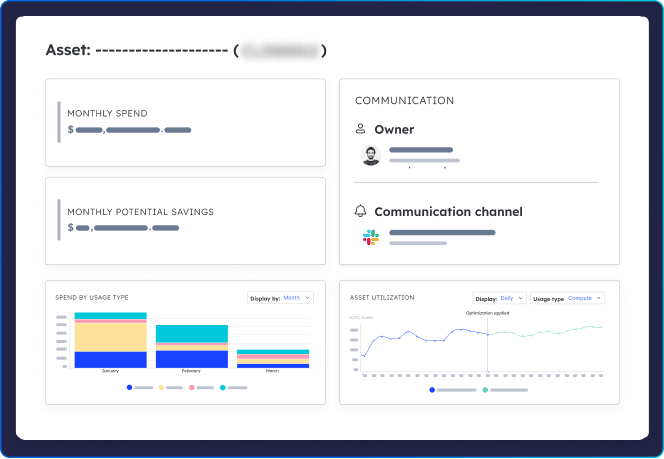
Through continual cross-referencing, it becomes possible to construct dynamic infrastructure ownership graphs (living maps that reflect who is actually responsible for a given resource based on how it was created and how it behaves) instead of a tag that hasn’t been updated in months, eliminating the tagging problem at its root. This is the mechanism Cloud ex Machina (CxM) uses to solve the attribution trap: it constructs dynamic ownership from deployment patterns, repository activity, and IAM permissions, no manual tagging required.

2. The Context Gap
Even when ownership is resolved, a second failure mode emerges: alerts without context. A notification flagging an underutilized RDS instance or an oversized compute cluster is technically accurate but operationally incomplete.
The Problem: Decontextualized Alerts Stall Remediation
The engineer receiving a generic cost alert has no immediate way to determine:
- Whether the resource is genuinely idle or serving a dependency that isn't immediately visible.
- Whether the recommended remediation carries downstream risk.
- What investigative steps are needed before it is safe to act.
Acting on a decontextualized alert requires checking architecture diagrams, querying monitoring tools, and tracing service dependencies before any action can be safely taken. Most engineers, under existing workload pressure, will defer that investigation indefinitely. The alert closes without action, waste continues, and the governance program loses credibility as a reliable source of signal.
The Solution: Context-Rich Infrastructure Intelligence
Context-rich infrastructure intelligence addresses this issue by combining billing data with runtime metrics and architecture context before a recommendation is ever surfaced. Each recommendation is delivered with:
- A specific workload and service tied to the finding, rather than a generic resource identifier.
- Relevant performance and utilization data that supports the assessment.
- Safe remediation guidance that accounts for known service dependencies.
The engineer receives a complete enough picture to make a confident decision or to escalate with the right information already in hand. Recommendations framed this way get acted on while generic alerts don’t.
3. The Workflow Disconnect
When governance insights are delivered through a dedicated FinOps dashboard, engineers must context-switch out of their development environment to engage with them.
The Problem: Dashboard-Driven Governance Gets Ignored
That context switch carries a compounding cost:
- It interrupts engineering focus and adds cognitive overhead to an already loaded workday.
- It reinforces the perception that cloud cost work is a separate job from engineering work.
- It means governance dashboards get checked infrequently, often only after a budget alarm has already escalated to management.
The insights those dashboards contain are not wrong. They are simply inaccessible within the rhythm of how engineers actually work.
The Solution: Workflow-Integrated Governance
Workflow-integrated governance eliminates that friction by delivering cost and ownership signals directly through the tools engineers already use:
- Slack notifications surface cost anomalies with enough context to evaluate and act on immediately.
- Jira tasks carry optimization recommendations that are already scoped and assigned, ready to be pulled into a sprint.
- Pull requests surface resource governance issues directly alongside the relevant code change already under review.
Engineers resolve governance issues without leaving their workflow, which means they resolve them consistently, rather than deferring them to a dashboard visit that may never come.
Governance Principles for Cloud-Based Solutions

Effective cloud governance is a continuous balancing act across three distinct optimization levers. Treating them in isolation produces diminishing returns; waste at one layer will offset gains at another.
Cloud Governance Optimization Layers Summary
|
Lever |
What It Addresses |
Common Failure Mode |
Key Metric |
|
Usage |
Volume of resources consumed |
Unowned idle and orphaned resources |
% of spend with verified ownership |
|
Configuration |
How resources are sized and architected |
Over-provisioned active workloads |
Right-sizing coverage across active fleet |
|
Rate |
Cost per unit of cloud resource |
Misaligned or stale commitments |
Commitment utilization rate |
Lever 1: Usage Optimization
Usage optimization addresses how much cloud resource is consumed in the first place, like idle resources left running after a project ends, always-on development environments, orphaned storage volumes, and over-provisioned compute sized for peak load that never materialized.
Unlike rate optimization, usage waste is largely an ownership and accountability problem. Resources go idle because ownership was never clearly established. This is why automated attribution is foundational to usage governance. You can't systematically eliminate waste you can't reliably assign to an owner. Usage reduction also benefits most from project-driven framing: a discrete project with a defined baseline, measurable target, and named owner converts a vague organizational aspiration into an actionable commitment.
Lever 2: Configuration Optimization
Configuration optimization addresses how resources are architected and sized relative to actual demand: right-sizing compute, selecting appropriate storage tiers, tuning databases, and aligning network architecture with real traffic patterns.
Configuration waste is the hardest to detect because it doesn't look like waste: the resources are active and serving real workloads, just at a higher cost than necessary. A recommendation to downsize a compute instance is only actionable when accompanied by evidence that it's genuinely over-provisioned relative to observed utilization, not just a theoretical benchmark. Context is what separates a recommendation engineers act on from one they dismiss as potentially disruptive.
Lever 3: Rate Optimization
Rate optimization covers what you pay per unit of cloud resource: reserved capacity, savings plans, committed use discounts, and spot strategies where workloads permit. The most common failure mode isn't underinvestment in commitments; it's misaligned ones. Organizations purchase reserved instances based on historical patterns that no longer reflect current workloads, then carry underutilized commitments that quietly erode the savings they were intended to generate.
Rate-based strategies like spot instances also carry real operational trade-offs. Interruption risk, architectural complexity, and preemption handling mean they aren't universally applicable, and treating them as straightforward cost levers without acknowledging the engineering investment they require leads to brittle infrastructure.
Applying All Three Levers Together
The interaction between levers is what makes the three-lever model more powerful than any single-lever approach. Usage cleanup without configuration review eliminates idle resources but leaves active ones consuming more than necessary. Configuration tuning without rate alignment misses the opportunity to match optimized workloads to the most cost-effective purchasing model. Rate optimization without usage governance means paying discounted prices for resources that shouldn't be running.
Governance programs that track progress across all three levers, with distinct KPIs for each, give engineering teams a complete picture of where efficiency gains are available and which projects to prioritize.
Implementing Multi-Cloud Governance Solutions
Most enterprises don't choose multi-cloud: it accumulates. An acquisition brings an Azure footprint. A team standardizes on GCP for machine learning. Core infrastructure runs on AWS. Before long, engineering and FinOps teams are navigating three separate billing models, three distinct resource taxonomies, and three sets of native cost tools.
The governance challenge this creates is inconsistency. Each provider defines resources, cost dimensions, and ownership constructs differently: what AWS calls a tag, Azure calls a label. Enforcing a unified governance policy using native tooling means constantly translating between frameworks and losing context in the process.
The Limits of Provider-Native Tooling
AWS Cost Explorer, Azure Cost Management, and Google Cloud Cost Management are each well-suited to their own environments but share a structural limitation: they're designed to answer questions about their own cloud, not your infrastructure as a whole.
|
Capability |
Provider-Native Tools |
Unified Governance Platform |
|
Billing visibility |
Per-provider only |
Consolidated across all clouds |
|
Resource ownership |
Manual tagging per provider |
Inferred automatically across providers |
|
Cost anomaly detection |
Siloed per cloud account |
Cross-cloud pattern detection |
|
Optimization recommendations |
Provider-specific |
Workload-aware across full stack |
|
Workflow integration |
Limited |
Native delivery via Slack, Jira, Git |
|
Commitment management |
Per-provider purchasing |
Unified commitment group analysis |
|
Granular context |
Billing data only |
Billing combined with runtime metrics |
Unifying Without Losing Granularity
A unified dashboard that aggregates billing data is a necessary starting point, but consolidation alone only addresses visibility. It doesn't resolve the attribution problem, the context gap, or the workflow disconnect outlined earlier. A unified view without reliable ownership attribution (and without surfacing that information where engineers work) reproduces the FinOps Paradox at a greater scale.
Effective multi-cloud governance solutions unify data without flattening it, effectively maintaining granular context like service-level cost breakdowns, workload-specific utilization, and per-resource ownership within a single normalized framework that works consistently whether engineers are working with EKS on AWS, AKS on Azure, or GKE on GCP.
Applying the Three Levers Across Providers
Multi-cloud environments complicate all three optimization levers simultaneously. Rate optimization requires managing AWS Reserved Instances, Azure Reserved VM Instances, and GCP Committed Use Discounts under a single commitment strategy, each with different term structures and utilization mechanics. Usage governance requires an ownership graph spanning all three providers. Configuration optimization requires right-sizing recommendations that account for different instance families and performance characteristics across clouds.
Organizations managing each cloud in isolation will consistently find that gains in one environment are offset by unchecked waste in another.
A unified governance platform that normalizes all three levers across providers and delivers insights through engineering workflows rather than separate dashboards is the only architecture that scales with multi-cloud complexity rather than against it.
Centralized Cloud Governance Solutions at Scale
Cloud governance that relies on periodic reviews and manual follow-up doesn't scale. Three practices define how mature organizations move from ad hoc cost management to systematic, measurable governance.
Action Boards: Governance Tied to Business Targets
The first shift is moving from generic cost dashboards to action boards structured around custom KPIs: ESR efficiency ratios, idle resource reduction targets, commitment utilization rates, or per-service cost benchmarks aligned to product margins.
The framing difference matters. A dashboard showing total monthly spend provides context but no direction. An action board showing a team is at 67% of its idle reduction target creates accountability and forward momentum. KPIs should be defined collaboratively between engineering leads and finance stakeholders, ensuring what gets measured reflects actual business outcomes, not abstract cloud metrics. Action boards also make governance legible at the executive level, giving leadership a clear signal on whether the organization is improving its cloud value ratio and which teams are driving or lagging that trend.
Project-Driven Optimization: Structuring Waste Reduction as Engineering Work
The second practice is structuring waste reduction as discrete, measurable projects rather than standing background initiatives. A directive to "reduce cloud waste" has no deadline, no definition of done, and no natural owner. A project to eliminate idle development environment spend by 40% within a defined quarter has all three.
Project-driven optimization applies the same care engineering teams use for product development:
- A defined baseline establishes the current state.
- A specific, time-bound target sets a clear definition of success.
- Named ownership assigns accountability to a team or individual.
- Progress tracking keeps work visible throughout execution, not just at review time.
Unrecovered idle spend is budget, engineering capacity, and product investment the organization isn't getting back.
Cloud Governance, Security, and Reliability
Cloud cost governance and infrastructure security are typically managed as separate disciplines. In practice, they share the same foundation: the configuration decisions that drive unnecessary spend are frequently the same ones that expand the attack surface and introduce reliability risk.
Overprovisioning as a Security and Reliability Liability
An overprovisioned environment is structurally harder to secure. Every idle or unowned resource represents an additional entry point that needs to be monitored, patched, and access-controlled:
- Unowned resources go unmonitored. No one is applying security updates or watching for anomalous behavior, making them attractive targets.
- Manual audits can't keep pace. Idle and orphaned resources accumulate faster than periodic reviews can track them.
- Overprovisioning masks reliability assumptions. A cluster sized well beyond actual demand may appear stable, but failover behavior, autoscaling thresholds, and resource availability under unexpected load remain untested.
Governance tooling that automatically identifies and attributes orphaned resources systematically reduces unmonitored entry points, closing security gaps that would otherwise require a separate audit initiative to surface.
Paying Down Reliability Debt Through Configuration Intelligence
Configuration drift (the gradual divergence between how infrastructure was designed and how it actually operates) is one of the most underappreciated sources of both cost waste and reliability risk. A database tuned for a traffic pattern that no longer exists represents reliability debt that grows silently until it surfaces as an incident.
Connecting configuration data with runtime performance metrics makes this debt visible before it becomes a problem:
- Right-sizing recommendations grounded in observed utilization identify cost savings and surface configuration misalignments simultaneously.
- An oversized compute instance flagged as a cost target also reveals whether it's genuinely over-provisioned or masking a workload that legitimately requires its allocated capacity.
- Configuration intelligence distinguishes between waste and headroom, a distinction that's critical before any remediation action is taken.
Governance Changes That Respect SLAs
The practical barrier to acting on right-sizing recommendations is the legitimate concern that governance-driven changes will violate SLA commitments. A right-sizing action applied without workload context can degrade response times or trigger cascading failures in latency-sensitive services.
Effective governance tooling addresses this by incorporating SLA and performance constraints directly into the recommendation engine:
- Changes are evaluated for compatibility with observed performance baselines and service level objectives and cost impact.
- A recommendation that reduces spend by 20% but pushes a critical service's p99 latency above its SLA threshold should be flagged as high-risk, not surfaced as a straightforward optimization.
- Engineering teams need recommendations they can act on with confidence. That confidence depends on the platform understanding reliability implications alongside financial projections.
The Role of Commercial Cloud Governance Solutions

The commercial FinOps tooling market has matured significantly, but not all platforms have evolved at the same rate. Understanding where a given tool sits in that evolution is essential before committing to a governance platform at scale.
Three Generations of Cloud Governance Tooling
- First-generation platforms focused on billing aggregation and spend visualization. They answered, "How much are we spending?" but offered little guidance on what to do about it. Attribution was manual, recommendations were generic, and acting on findings required engineers to leave their tools entirely.
- Second-generation platforms added anomaly detection, tagging enforcement, and basic optimization recommendations. However, the delivery mechanism remained unchanged: a dashboard engineers had to seek out, interpret, and act on independently.
- Third-generation platforms shift from passive reporting to active delivery. This surfaces ownership alerts, optimization recommendations, and governance actions directly inside the tools engineers already use.
Why "Autonomous" Governance Fails the Trust Test
Full autonomy (automatically remediating cost issues without human intervention) consistently fails the trust test with engineering teams:
- Context blindness. Automated remediation optimizes for cost signals without understanding workload dependencies or SLA constraints. Terminating an instance flagged as idle that's actually serving a scheduled batch job erodes trust immediately and durably.
- Lack of auditability. When an autonomous action causes a downstream incident, there's no clear record of what changed or why, incompatible with how SREs manage production environments.
- Ownership ambiguity. Autonomous changes without assigned ownership create accountability gaps that become critical when something breaks.
The more durable model is human-in-the-loop governance: the platform identifies, attributes, and contextualizes optimization opportunities, then delivers them as actionable recommendations with the engineer making the final call.
Dashboard-Led vs. Workflow-Integrated Governance
|
Capability |
Dashboard-Led Governance |
Workflow-Integrated Governance |
|
Insight delivery |
Engineer checks dashboard |
Delivered via Slack, Jira, Git |
|
Ownership attribution |
Manual tagging required |
Inferred automatically |
|
Remediation workflow |
Context switch required |
Resolved within existing tools |
|
Recommendation context |
Cost data only |
Cost, performance, and dependency data |
|
SLA awareness |
Not typically included |
Validated against performance thresholds |
|
Auditability |
Limited |
Full action and verification record |
|
Engineering adoption |
Low, requires behavior change |
High, meets engineers where they work |
|
Closed-loop verification |
Manual reconciliation |
Automated before-and-after analysis |
The distinction between these models is the difference between a governance program engineering teams actively engage with and one that operates as background noise until a budget review forces attention.
Data Governance Cloud Solutions: Automating the Handoff
The most persistent bottleneck in cloud governance is the distance between a validated recommendation and an implemented fix. Automating that handoff eliminates the delay entirely.
AI-Powered Remediation: From Signal to Implementation-Ready Code
The AI-powered remediation engine translates a finding signal directly into an implementation-ready code change: a Terraform module update, a Kubernetes YAML adjustment, or an infrastructure policy modification scoped to the affected resource.
Translating a cost recommendation into infrastructure code manually is non-trivial: locating the relevant configuration, determining the correct target size, validating against module dependencies, and submitting the change for review. AI-powered remediation handles that translation automatically. The engineer's role shifts from writing the fix to validating it, which is a significantly lower-friction interaction that can realistically compete for attention in a crowded sprint.
Multi-Channel Execution: Fixes Delivered Where Work Happens
A remediation that exists only inside a governance platform still requires a context switch to act on. Multi-channel execution closes that gap:
- GitHub Pull Requests surface infrastructure changes as reviewable, mergeable code integrated directly into the version control workflow where configuration changes already live.
- Slack notifications deliver time-sensitive anomalies and ownership alerts with enough context to act on immediately.
- Jira tasks carry scoped optimization recommendations that are already defined and assigned, ready to pull into a sprint without additional triage.
The channel matters as much as the content. A well-contextualized recommendation delivered through the wrong channel has the same practical outcome as no recommendation at all.
Reverse Mapping: Connecting Runtime Waste to Its Source
When an orphaned resource or misconfigured deployment is flagged, most governance platforms identify what the problem is and what it costs, but not where it originated or who created it. Reverse mapping closes that gap:
- Orphaned resources are linked to the deployment that created them, not just flagged as unowned.
- Right-sizing opportunities are tied to the specific infrastructure module where the misconfiguration lives, making fixes faster to locate and implement.
- Ownership is established from the codebase outward, creating a feedback loop that surfaces the cost implications of infrastructure decisions at the source rather than weeks later.
Together, these three capabilities convert the governance handoff from a manual, multi-step process into an automated workflow that reduces the time between identifying a problem and implementing a fix from weeks to hours.
Conclusion: The Future of Cloud Governance Is Engineering-Led
The tools, data, and optimization frameworks available today for cloud governance are more capable than ever, and yet the average organization still wastes more than a quarter of its cloud spend. The gap is structural.
Visibility without workflow integration only documents waste. Dashboards, tagging initiatives, and FinOps programs that operate at arm's length from engineering teams generate findings that require too many handoffs and too much manual effort to act on consistently at scale.
Engineering-led governance closes that connection:
- Ownership is established automatically from deployment signals and infrastructure metadata.
- Optimization is structured as projects with defined baselines, measurable targets, and named owners.
- Governance actions are delivered through engineering workflows through pull requests, Slack, and Jira, so resolving a cost issue requires no more friction than resolving any other engineering task.
- All three optimization levers—usage, configuration, and rate—are managed continuously and in coordination, rather than addressed reactively and in isolation.
The organizations that will consistently outperform on cloud efficiency aren't those with the largest FinOps teams or the most sophisticated dashboards. They're the ones that have made cost awareness a natural byproduct of how their engineers build and deploy.
Cloud ex Machina (CxM) is built specifically for that model, a developer-first platform that automates ownership attribution, delivers governance actions through the tools engineers already use, and closes the loop between cost visibility and engineering action.
To see how CxM maps to your infrastructure and engineering workflows, book a demo with the CxM team.