

AI workloads are quickly becoming the fastest-growing and least predictable source of cloud spend. GPU instances, short-lived experiments, automated deployments, and AI-generated infrastructure decisions can multiply costs faster than any traditional review process can keep up.
Most teams respond by applying the same FinOps playbooks they used for VM-based workloads: dashboards, tagging standards, and monthly reviews. Those approaches were never designed for AI-driven infrastructure—and they fail precisely when teams scale AI usage.
FinOps for AI is not about better reporting. It is an execution framework designed to keep pace with AI-driven infrastructure decisions and prevent cost amplification before it compounds.
Note: this guide covers infrastructure-level AI costs—compute, IaC, and experiment sprawl. Token-based and LLM inference costs are out of scope here.
Key Takeaways
- AI workloads increase cloud spend faster than human review loops can operate
- Traditional FinOps cloud cost optimization strategies break under GPU-heavy, experiment-driven usage
- AI for FinOps focuses on continuous analysis, automated ownership, and remediation
- Usage, configuration, and rate optimization must work together to control AI-driven waste
- Automation—not dashboards—is required to keep costs aligned with engineering velocity
- Cost-aware habits can be embedded into AI workflows without slowing teams down
What Is FinOps for AI—and What Problem Is It Actually Solving?
AI for FinOps is best understood as an execution framework for managing AI-driven cost amplification, not a financial reporting discipline. AI changes how infrastructure is created, modified, and scaled—often automatically and continuously. As a result, costs are no longer introduced through deliberate, human-reviewed decisions. They emerge as a byproduct of AI-assisted development, experimentation, and deployment. AI for FinOps exists to make those costs controllable in real time, without slowing teams down.
The Core Problem It Addresses
AI dramatically increases the rate at which infrastructure decisions are made. Models generate infrastructure-as-code (IaC), pipelines deploy new environments automatically, and experimentation spins up GPU-heavy workloads on demand. The speed and volume of these changes quickly exceed what traditional review processes were designed to handle.
Human review loops cannot keep up. Monthly or even weekly cost reviews assume that infrastructure changes are relatively infrequent and that someone can trace a cost spike back to a decision-maker. In AI-driven environments, that assumption breaks down. By the time a review happens, the infrastructure—and the cost behavior—has already changed multiple times.
How FinOps for AI Helps
FinOps for AI works by translating AI-driven infrastructure behavior into actionable signals that engineering teams can actually use. Instead of surfacing abstract cost anomalies, it connects spend to concrete infrastructure actions, environments, and workloads as they happen.
Crucially, it replaces manual review with automated, context-aware remediation. Rather than asking humans to investigate every spike, FinOps for AI systems continuously analyzes usage patterns, configuration choices, and deployment behavior, then guides or applies corrective action automatically. This allows teams to stay ahead of cost issues instead of reacting after waste has already accumulated.
Why This Is Different From Traditional FinOps Cloud Cost Optimization Strategies
Traditional FinOps cloud cost optimization strategies assume that costs accumulate slowly enough to be reviewed periodically. AI systems invalidate that assumption. AI-generated code and automated pipelines can create a meaningful cost impact in hours or minutes—making monthly or weekly review cycles ineffective as a control mechanism.
Ownership also becomes ambiguous. When AI systems generate infrastructure, it is often unclear which team or individual “owns” the resulting resources. Traditional FinOps relies heavily on manual tagging and explicit ownership models, which tend to break down under automated, high-velocity change.
FinOps for AI addresses these gaps by operating continuously, inferring ownership automatically, and focusing on execution rather than retrospective analysis. The goal is not to produce better reports but to ensure that AI-driven infrastructure decisions remain aligned with cost efficiency as they are made.
Why AI Workloads Break Traditional Cost Controls
AI-assisted development fundamentally changes the scale and frequency of infrastructure creation, which means that cost grows exponentially while review capacity grows linearly. Even well-staffed teams cannot manually review infrastructure decisions at the same pace as AI systems produce them. Traditional cost controls, which rely on human checkpoints, quickly fall behind. Each engineer can spin up far more services than before because much of the scaffolding, configuration, and deployment logic is generated automatically. Features that once shared environments now often receive their own isolated stacks, multiplying infrastructure footprint across development, staging, and testing.
At the same time, redeployments and reconfigurations become more frequent. AI-generated changes encourage rapid iteration, small incremental updates, and constant experimentation. Infrastructure is no longer something teams “set up and live with” for long periods—it is continuously created, modified, and replaced.
New Problems AI Introduces
AI-generated infrastructure often comes into existence without any built-in understanding of cost. The configurations produced by AI systems are usually optimized for correctness and performance, not efficiency. As a result, they tend to select powerful instance types, premium storage options, or aggressive scaling settings by default. Individually, these choices may seem reasonable, but at scale, they quietly introduce persistent, unnecessary spend.
GPU-heavy workloads amplify this problem. In AI environments, small configuration mistakes have an outsized financial impact. An oversized accelerator, a poorly tuned training job, or an inefficient scaling policy can multiply costs far more quickly than similar missteps in traditional compute environments. What would once have been a minor inefficiency becomes a major budget issue.
AI experimentation also leaves behind a long tail of abandoned infrastructure. Teams move quickly from one experiment to the next, but the resources created to support those experiments—training clusters, storage volumes, temporary environments—are often left running. Cleanup rarely feels urgent, and ownership is unclear, so these resources continue consuming budget long after their purpose has ended.
Compounding the issue, cost spikes caused by AI workloads often appear justified. Increased spend aligns with visible innovation: new models, new features, faster iteration. Because the costs correlate with progress, inefficiencies are harder to challenge. Waste hides in plain sight, masked by the pace of experimentation and delivery.
How FinOps for AI Helps Mitigate These Risks
FinOps for AI replaces periodic, retrospective reviews with continuous analysis that operates at the same pace as AI-driven change. Instead of waiting for cost anomalies to surface weeks later, systems evaluate usage, configuration, and deployment behavior as it happens.
Automated ownership attribution ensures that even AI-generated infrastructure is tied to a responsible team or service. This removes ambiguity and prevents resources from lingering simply because no one knows who owns them.
Finally, cost-aware defaults and guardrails guide AI output before it becomes expensive infrastructure. By shaping decisions upstream—through safer configurations, enforced limits, and automated checks—FinOps for AI prevents waste rather than relying on cleanup after the fact.
AI Infrastructure Optimization Techniques That Reduce AI-Driven Waste

Effective FinOps for AI relies on three complementary optimization layers:
1. Usage-Level Optimization: Mitigating AI Experiment Sprawl
Problem: AI creates many short-lived, partially used resources.
How Usage-Level Optimization Helps
- Automatic detection of idle GPUs and abandoned training jobs
- Environment-aware cleanup policies that distinguish production from experimentation
- Scheduling guardrails that shut down unused training resources automatically
This prevents experimentation from silently turning into permanent spend.
Consider a typical AI experiment environment: a team spins up a p3.2xlarge ($3.06/hr in us-east-1) for a training run, then moves to the next experiment without shutting it down. Over 72 hours of idle time, that’s $220 in preventable waste — multiplied across a team of 10 engineers running weekly experiments, that’s over $100K/year from a single misconfiguration pattern. Usage-level optimization catches this by detecting idle GPU utilization and triggering an environment-aware cleanup policy.
2. Configuration-Level Optimization: Preventing Costly AI Defaults
Problem: AI-generated infrastructure selects expensive defaults.
How Configuration-Level Optimization Helps
- Detects overpowered instance types and accelerators
- Flags inefficient storage and network configurations
- Recommends safer, cost-effective alternatives automatically
Configuration optimization is critical because AI tends to over-provision “just in case.”
3. Rate-Level Optimization: Avoiding Commitment Traps
Problem: AI workloads are volatile and hard to forecast.
How Rate-Level Optimization Helps
- Commitment strategies based on real workload behavior—not averages
- Reduced overcommitment risk while still capturing savings
- Alignment of commitments with actual AI usage patterns
This allows teams to benefit from discounts without locking themselves into commitments that AI workloads may outgrow or abandon.
FinOps Automation Strategies for AI-Generated Infrastructure
AI-driven infrastructure changes at a pace that makes manual cost governance impractical. When environments, services, and workloads are created automatically, cost controls must operate with the same level of automation. FinOps automation for AI is not about removing humans from the loop entirely—it is about ensuring that human judgment is applied where it matters most, while routine detection and remediation happen continuously in the background.
Why Automation Is Non-Negotiable for AI
AI systems can create and modify infrastructure faster than humans can reasonably review it. IaC generated by AI, automated deployment pipelines, and experimentation frameworks all contribute to an environment where cost-impacting decisions are made continuously, often without explicit human intent. In this context, manual FinOps processes quickly become bottlenecks rather than safeguards.
When cost controls rely on human review, teams are forced to choose between speed and governance. Over time, governance loses. Engineers bypass manual checks to keep delivery moving, and cost optimization becomes reactive, delayed, and increasingly disconnected from day-to-day work. Automation is required not to enforce control, but to preserve it without slowing teams down.
Manual Cost Controls vs. Automated FinOps for AI
|
Dimension |
Manual / Traditional Cost Controls |
Automated FinOps for AI |
Practical Impact |
|
Decision latency |
Days or weeks between cost creation and review |
Continuous, near-real-time evaluation |
Prevents waste from compounding before action is taken |
|
Scalability with AI output |
Breaks down as AI generates infrastructure faster than humans can review |
Scales at the same pace as AI-driven infrastructure changes |
Cost controls remain effective as AI usage grows |
|
Ownership attribution |
Relies on manual tagging and human investigation |
Automatically infers ownership from infrastructure context and workflows |
Eliminates ambiguity that causes cost issues to linger |
|
Engineer workload |
Requires investigation, meetings, and manual cleanup |
Routine detection and remediation handled automatically |
Engineers stay focused on delivery instead of cost triage |
|
Cost regression risk |
Previously fixed issues frequently reappear |
Guardrails prevent known inefficiencies from being reintroduced |
Optimization improves over time instead of eroding |
|
Integration with workflows |
Exists outside engineering tools as reports or dashboards |
Embedded directly into CI/CD, MLOps, and collaboration tools |
Cost optimization becomes part of normal engineering work |
|
Effect on delivery velocity |
Creates friction and delays due to manual gates |
Preserves speed by automating control without blocking progress |
Teams move fast without losing cost control |
Closing the Loop on AI Cost Control
Automation transforms FinOps for AI from a reactive discipline into a continuous control system. By detecting issues early, assigning ownership automatically, and guiding remediation within existing workflows, teams can maintain cost efficiency without slowing innovation. The result is not tighter oversight, but smarter execution—where AI-driven infrastructure remains fast, flexible, and economically sustainable by default.
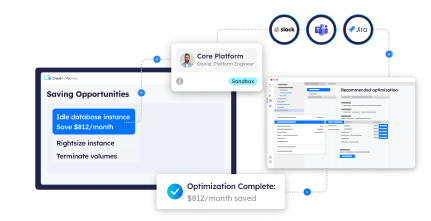
Tools like CxM operationalize this loop by identifying AI-driven waste — idle GPU resources, overpowered instance types selected by AI-generated IaC, or orphaned experiment environments — mapping each finding to a named owner, and proposing a remediation plan that can translate directly into a Jira ticket or a Terraform PR for an engineer or their coding agent to act on. CxM identifies the problem and proposes the fix; the team decides to act.

Best AI Tools for Cloud FinOps: Evaluating Risk Reduction, Not Features
When evaluating AI tools for cloud cost optimization, feature checklists are misleading. The real question is whether the tool reduces risk at AI speed. In AI-heavy environments, the primary risk is not lack of visibility—it is delayed action. The best AI tools for cloud FinOps are those that reduce risk by shortening the time between cost creation and cost correction, without introducing friction into engineering workflows.
What to Evaluate Instead of Features
Rather than comparing tools based on dashboards, reports, or the number of supported services, teams should evaluate how well a tool reduces AI-driven cost risk in practice.
- Time to remediation: The most important metric is how quickly a cost issue can move from detection to resolution. In AI environments, even short delays allow waste to compound rapidly, so tools must minimize investigation time and handoffs.
- Reduction in AI-driven waste: Effective tools do not just identify waste once; they prevent the same issues from recurring. Look for systems that learn from past remediations and apply guardrails to stop repeated inefficiencies.
- Ability to keep pace with AI output: AI systems generate infrastructure changes continuously. A viable tool must operate continuously as well, without relying on periodic scans or manual review cycles that quickly fall behind.
- Quality of ownership attribution: Cost signals are only actionable when ownership is clear. Tools should automatically connect AI-generated infrastructure to responsible teams or services, without relying entirely on perfect tagging.
- Safety and confidence of remediation: Engineers need to trust that acting on a recommendation will not break production workloads. Tools that provide context, impact estimates, and safe remediation paths dramatically increase follow-through.
Best AI Tools for Cloud FinOps: Comparison by Risk Reduction Capability
|
Tool |
Best For |
Primary Risk Reduced |
Typical Automation Level |
Ideal Use Case |
|
Continuous, developer-first AI cost remediation |
AI-driven waste from unclear ownership, misconfigurations, and delayed action |
High (AI-proposed plans with human or agent-driven execution) |
Engineering-led organizations running AI at scale that need cost control without slowing delivery |
|
|
Automated, safe remediation |
Performance and cost risk from misconfigured workloads |
High (Autonomous with guardrails) |
Teams that want AI to continuously optimize infrastructure without risking reliability |
|
|
Autonomous Kubernetes optimization |
Container waste and Spot instance risk |
High (Autonomous) |
Platform teams running AI workloads primarily on Kubernetes |
|
|
AI-agent-driven multi-cloud governance |
Persistent waste across complex multi-cloud estates |
High (Autonomous) |
Organizations needing always-on governance across AWS, Azure, and GCP |
|
|
Low-risk commitment management |
Over- or under-commitment to RIs and Savings Plans |
High (Hands-off) |
Teams with large, fluctuating AWS spend that want safer discount capture |
|
|
High-impact compute waste reduction |
Excess on-demand compute usage |
Medium–High (Policy-driven) |
Workloads that can tolerate interruption for aggressive savings |
|
|
100% cost allocation accuracy |
Financial blind spots from missing or inconsistent tags |
Medium (Advisor) |
FinOps teams needing precise allocation across teams and services |
|
|
Engineering-driven cost intelligence & unit economics |
Lack of business context behind cloud spend |
Low (Intelligence) |
Engineering orgs optimizing cost per customer, feature, or workload |
Key Considerations
AI cost management is evolving rapidly, and buyers should evaluate tools through a forward-looking lens.
- AI / LLM cost tracking: As GenAI adoption increases, visibility into GPU usage, token-based pricing, and model-level cost attribution is becoming essential. Some platforms are beginning to lead in this area, but maturity varies widely.
- Agentic AI: The market is shifting toward AI agents that act as co-pilots rather than passive dashboards. Tools that can safely take action—or strongly guide it—will increasingly outperform visibility-only platforms.
- FOCUS compatibility: Support for the FinOps Open Cost and Usage Specification (FOCUS) is becoming a baseline requirement for standardized reporting and cross-tool interoperability in multi-cloud environments.
Tips for Avoiding Dashboard Fatigue in AI-Heavy Environments
1. Push insights to where work happens
Engineers should not be expected to monitor yet another dashboard to manage AI costs. Instead, cost signals need to appear directly inside the tools where work already happens, such as version control systems, chat tools, or ticketing platforms. When optimization becomes part of normal workflows, it stops feeling like an external obligation and starts feeling like routine engineering work.
2. Limit signals to actionable events
AI environments generate a constant stream of anomalies, many of which do not require immediate action. Surfacing everything overwhelms teams and trains them to ignore alerts altogether. Only signals with a clear owner, a safe remediation path, and meaningful impact should reach engineers, ensuring that attention is reserved for issues worth acting on now.
3. Replace dashboards with project views
Dashboards encourage passive observation rather than execution. Project-based views, on the other hand, frame cost optimization as concrete work with clear goals, owners, and outcomes. By tying AI cost issues to specific objectives—such as improving GPU utilization or reducing cost per model run—teams can track progress and verify impact instead of staring at fluctuating spend graphs.
4. Use guardrails, not alerts, to shape behavior
Alerts react to problems after they occur, while guardrails prevent problems from being created in the first place. In AI-heavy environments, guardrails such as safe defaults, automated checks in CI/CD and MLOps pipelines, and continuous enforcement reduce the need for human intervention. Over time, this dramatically lowers alert volume and cognitive load.
5. Measure fewer metrics—but tie them to outcomes
More metrics do not lead to better decisions; they increase noise. Teams should focus on a small number of AI-relevant KPIs that directly influence decisions, such as utilization efficiency or cost per experiment. Any metric that does not clearly drive remediation or improvement should be removed to keep focus on outcomes, not observation.
Building Cost-Aware Habits for Teams Using AI Every Day

AI changes how engineers build, experiment, and deploy infrastructure on a daily basis. As a result, cost outcomes are increasingly determined by routine decisions made during development—not by one-time architectural choices or periodic reviews. Building cost-aware habits ensures that AI-driven velocity does not translate into uncontrolled spend. The goal is not to slow teams down or add financial friction, but to embed lightweight, repeatable behaviors into existing workflows so cost efficiency becomes a natural byproduct of how work gets done.
How to Embed Cost Awareness Into Existing Processes
1. AI-Assisted Development
- Introduce cost-aware templates for AI-generated infrastructure
- Enforce safe defaults automatically
2. IaC
- Add automated cost checks into pull requests
- Prevent expensive misconfigurations before deployment
3. Experimentation Workflows
- Apply automatic expiration policies
- Require explicit promotion paths for experiments moving to production
How FinOps for AI Helps Teams Learn Without Slowing Down
FinOps for AI enables learning by:
- Providing feedback at the moment decisions are made
- Automating remediation instead of blocking progress
- Allowing teams to experiment safely without runaway costs
Cost optimization becomes a background system, not a manual process that engineers must remember.
Conclusion: FinOps for AI Is About Execution, Not Reporting
AI has changed the economics of cloud infrastructure. Costs are created faster, ownership is less obvious, and traditional review cycles cannot keep up.
FinOps for AI succeeds when it:
- Operates continuously
- Automates ownership and remediation
- Embeds cost awareness directly into engineering workflows
Teams that adopt FinOps for AI do not slow down innovation. They remove friction, reduce waste, and allow engineers to move faster—without losing control of cloud spend.
If your AI workloads are growing faster than your ability to control costs, Cloud Ex Machina can help. CxM turns AI-driven cost signals into assigned, review-ready work by automatically attributing ownership and proposing remediation as a plan that can translate directly into a Jira ticket or your Terraform repo as a PR—so engineers or their coding agents can act on it immediately. Instead of chasing dashboards, teams execute on clear actions with verified outcomes—keeping cost efficiency aligned with engineering velocity.
See how CxM helps teams move from visibility to execution—without slowing delivery. Book a demo today.