

Cloud financial operations promise a way out of runaway infrastructure spend. But after years of dashboard adoption, framework certifications, and cost review meetings, a significant chunk of cloud spend (29% according to Flexera) continues to be wasted. If visibility were enough to fix the problem, it would already be fixed.
The question isn't what cloud FinOps is. Most engineering leaders already know. The question is why it keeps failing despite real investment and genuine effort. This article diagnoses the structural failures behind that pattern and closes with a practical starting sequence grounded in governance, ownership, and measurable targets.
Key Takeaways:
- Cloud FinOps fails not because teams lack data but because visibility without governance has no path to accountability. Ownership, spend policies, and enforcement mechanisms are what turn recommendations into action.
- The FinOps Paradox describes a specific failure mode: finance teams generate reports, engineering teams ignore them, and optimization stays deprioritized because no shared governance layer connects insights to action.
- Manual tagging, the industry's standard approach to cost attribution, breaks predictably at scale. Automatic attribution through inference from deployment patterns, code repositories, and permissions is the only approach that stays accurate as environments grow.
- Effective cloud FinOps covers three optimization levers: rate, usage, and configuration. Treating any one in isolation leaves significant efficiency opportunities unaddressed.
- Implementation should follow a governance-first sequence: establish ownership before setting targets, define spend policies before measuring compliance, and route remediation through existing engineering tools.
The Problem Cloud FinOps Exists to Solve
Cloud FinOps exists because waste remains a significant issue in cloud spending. Not because engineers are careless or finance teams are uninformed, but because the structural conditions of cloud infrastructure make cost accountability genuinely difficult. Resources are provisioned faster than ownership records can track them. Teams operate across multi-account environments where no single person has a complete picture. And the tools most commonly used to address this problem were designed to generate reports, not to produce the organizational conditions under which those reports get acted on.
The issue isn't data availability, either. Most engineering organizations have more cost data than they can meaningfully process. The issue is that data doesn't automatically become action, and without governance structures connecting visibility to accountability, it never will. Cloud financial operations is the discipline that builds those structures.
The FinOps Paradox
The FinOps Paradox describes a failure mode most teams will recognize: finance teams generate detailed cost reports, engineering teams ignore them or lack the context to act, and optimization stays perpetually deprioritized against delivery work. Nobody is negligent; it’s just the system doesn't create the conditions for action.
The core gap is structural, not motivational. There's no clear ownership for most resources, no workflow-native path from a cost insight to a remediation ticket, and no measurable definition of success. Optimization becomes a recurring agenda item that generates discussion but not outcomes.
Governance closes this loop. Without policies that define who owns a resource, what action is required when a threshold is crossed, and what the escalation path looks like when nothing happens, the visibility-to-action gap persists regardless of how good the dashboards are.
The Tagging Problem
Manual resource tagging is the standard approach to cost attribution in cloud environments. And it fails at scale in many predictable ways.
Tagging strategies degrade when teams ship fast, when infrastructure-as-code patterns vary across teams, when new services are provisioned without following the established taxonomy, or when organizations operate across multi-cloud environments. The failure isn't usually dramatic; rather, it accumulates over months with a few untagged resources here and a deprecated tag value there until attribution gaps are pervasive enough that the ownership model is no longer trustworthy.
Without reliable attribution, governance policies have nothing to attach to. Spend anomalies can't be routed to an accountable owner, and budget thresholds can't trigger the right alert. Any FinOps program built on an incomplete tagging foundation is building on unstable ground.
Attribution and Tagging Comparison
|
Attribution Challenge |
Where Traditional Tagging Breaks Down |
|
High deployment velocity |
New resources provisioned faster than tagging standards are applied |
|
IaC inconsistency |
Modules across teams use different tag schemas or omit tags entirely |
|
Multi-cloud environments |
Each provider has different native tag conventions and enforcement capabilities |
|
Organizational changes |
Team restructuring breaks historical tag accuracy |
|
Scale |
Manual tag audits become untenable above a few hundred active resources |
What Cloud Financial Operations Actually Covers

Cloud FinOps is the practice of connecting engineering decisions to business outcomes through structured optimization, governance, and accountability. A functioning program covers three distinct optimization levers, each addressing a different layer of cloud efficiency.
1. Usage Optimization
Usage optimization operates at runtime. It addresses idle and underutilized resources, over-provisioned compute and storage, workloads that run continuously when scheduled operation would reduce costs, and autoscaling policies not tuned to actual demand.
This is the layer most directly owned by the engineering teams closest to the workloads. A FinOps team can identify the idle staging database, but the team that provisioned it knows whether it's truly unused or depended on by a process that isn't obvious from the outside.
Governance here means defining what constitutes a policy violation. This will include what idle threshold triggers a notification, who receives it, and what the escalation path is if no action is taken.
2. Configuration Optimization
Configuration optimization is where engineering decisions made during development have the largest long-term cost implications. Expensive defaults, generational instance gaps, oversized compute allocations, and architectural patterns that create avoidable data transfer costs all fall into this category. Configuration problems are often baked in at provisioning and compound over time. A compute instance provisioned two sizes too large in a Terraform module deployed across dozens of environments creates ongoing waste at every deployment until the underlying configuration is corrected. Governance at this layer means establishing cost standards for resource provisioning, such as guardrails that prevent expensive misconfigurations from reaching production rather than catching them after the fact.
3. Rate Optimization
Rate optimization focuses on reducing the hourly rate paid for infrastructure the team is already committed to running. The primary mechanisms are commitment-based discounts like reserved instances, savings plans, enterprise discount programs, and similar constructs across cloud providers. The goal is capturing those discounts without over-committing to a capacity that becomes a liability when usage patterns change.
Getting rate optimization right requires understanding actual usage patterns across accounts and services, not just aggregate spend. As formal studies in cloud portfolio optimization demonstrate, relying on high-level estimates often masks widespread over-provisioning at the execution level. Commitment portfolios that look efficient at the organizational level frequently contain significant mismatches at the team or application level; specific services are over-committed and underutilized, while others are exposed entirely to expensive on-demand rates due to unpredictable team-level demand shifts.
From a governance perspective, rate optimization requires defined approval workflows for commitment purchases, clear portfolio ownership, and a review cadence that catches utilization drift before commitments auto-renew at suboptimal levels.
Optimization Lever Summary
|
Optimization Lever |
Example Actions |
Governance Touchpoint |
Primary Owner |
|
Usage |
Idle cleanup, scheduling, rightsizing, autoscaling tuning |
Idle thresholds, remediation timelines, escalation paths |
Engineering teams |
|
Configuration |
Instance generation updates, storage tier corrections, architectural fixes |
Provisioning standards, cost guardrails, IaC review |
Platform/DevOps + Engineering |
|
Rate |
RI purchases, Savings Plans, EDP commitments |
Commitment approval workflows, portfolio ownership |
FinOps + Finance |
FinOps vs. DevOps: How the Two Frameworks Intersect
The FinOps vs DevOps framing positions two disciplines as competing concerns, which misses the point. DevOps focuses on delivery velocity and operational reliability, while cloud FinOps focuses on the cost and efficiency of what DevOps ships and operates. Both break down when treated as separate concerns owned by separate teams with no shared governance layer.
What happens is familiar to most teams. A FinOps reporting function outside engineering workflows produces recommendations that require significant translation and has no authority to compel action. Cost reports land in inboxes. Engineers have delivery commitments. Nothing changes.
The resolution is shared governance. When both functions operate under the same cost policies, ownership models, and escalation paths, FinOps recommendations stop being advisory documents and start being actionable work items routed to the people who can execute them. That shared governance becomes operational through:
- Automated tickets in Jira with ownership assignment and estimated impact, so optimization work enters the engineering backlog alongside product priorities rather than competing with it from the outside.
- Pull requests in GitHub that implement infrastructure fixes directly, reducing the translation layer between a cost recommendation and an actionable code change.
- Alerts in Slack routed to the responsible team, surfacing policy violations and anomalies in the context where engineers are already working rather than in a separate dashboard they have to check.
FinOps vs. DevOps Summary
|
FinOps |
DevOps |
Where They Intersect |
|
|
Primary Focus |
Cost efficiency and financial accountability |
Delivery velocity and operational reliability |
Infrastructure provisioning decisions that affect both |
|
Primary Metrics |
Spend efficiency ratios, waste reduction, commitment utilization |
Deployment frequency, MTTR, change failure rate |
Unit economics: cost per deployment |
|
Tooling |
Cost platforms, billing APIs, commitment management |
IaC, observability, incident management |
Shared: Jira, Slack, GitHub, Terraform |
|
Governance Touchpoints |
Budget thresholds, ownership attribution, audit trails |
Change management, access controls, SLOs |
Cost policies in IaC, ownership in deployment standards |
Cloud FinOps and Cloud Governance: Where They Connect
Cloud governance defines the policies, controls, and accountability structures that determine how cloud resources are provisioned, owned, and managed. Cloud FinOps operates within and depends on that governance layer. Without it, FinOps programs produce insights that no one is accountable for acting on.
FinOps is not a governance framework itself. But it requires governance to function: ownership to route accountability, spend policies to define compliance, enforcement pathways to produce action, and audit trails to demonstrate results. Organizations that invest in FinOps tooling without building the underlying governance layer are optimizing the reporting function while leaving the accountability function empty.
Ownership as a Governance Requirement
Resource ownership is not a FinOps convenience; rather, it’s a governance requirement. Knowing which team or cost center (finance, marketing, or development) owns a resource determines who receives alerts, who is accountable for remediation, and who is responsible when spending exceeds policy thresholds.
Small-scale ownership can be maintained manually. But as environments grow, manual ownership records degrade faster than they can be maintained, resulting in new services getting provisioned without ownership assignment. When teams restructure, historical records don't follow.
Automatic attribution through inference from deployment patterns, code repositories, permission structures, and collaboration signals is the approach that remains accurate as environments grow. A living ownership model that updates as teams and workloads change is fundamentally different from a tagging strategy that degrades between audit cycles.
Spend Policies and Enforcement Pathways
The enforcement pathway matters as much as the policy definition. A spend policy that generates a monthly report and one that creates an ownership-tagged Jira ticket when a threshold is crossed are not equivalent, even if the policy logic is identical. The first creates awareness, while the second creates accountable work.
When this work is integrated into engineering workflows via automated ticket creation, pull request generation, and ownership-tagged alerts, enforcement becomes part of how teams work rather than an audit function they encounter quarterly.
Audit Readiness and Cost Accountability
For organizations under regulatory requirements or preparing for fundraising, cloud FinOps governance provides the audit trail connecting spend to ownership, decisions to justification, and optimization actions to verified outcomes. Audit-ready cloud FinOps means having attribution records, remediation histories, KPI progress documentation, and exception logs for resources intentionally excluded from optimization with the rationale on record.
This matters practically for engineering leaders demonstrating ROI to finance or executive stakeholders. The difference between "we reduced cloud spend by 18%" and "we reduced cloud spend by 18% against a target of 15%, with full attribution across 94% of active resources and documented exceptions for the remaining 6%" is the difference between a summary and an accountable governance record.
Where Cloud Governance and FinOps Connect Summary
|
Governance Requirement |
FinOps Capability |
What Breaks Without It |
|
Resource ownership |
Automatic attribution, ownership assignment |
Alerts route to wrong teams; accountability gaps persist |
|
Spend policy enforcement |
Threshold-triggered workflows, automated ticketing |
Policy violations surface in audits rather than at the time of occurrence |
|
Anomaly alerting |
Real-time detection, ownership-tagged notifications |
Cost spikes discovered weeks late via billing reports |
|
Audit trail |
Remediation history, KPI progress records, exception logs |
Inability to demonstrate optimization outcomes to leadership or auditors |
|
Exception management |
Intentional opt-out records with rationale |
No defensible basis for unaddressed optimization opportunities |
Building Cloud FinOps Habits Into Engineering Work

The sustainable version of Cloud FinOps is a set of habits embedded in how engineering work gets done, with cost-aware, governance-aligned decisions as a default rather than an initiative.
Cost Context at the Point of Decision
Engineers making infrastructure decisions should have access to cost impact data when they're making the decision, not two weeks later in a report. Surfacing cost context and governance constraints during resource provisioning reduces both waste and policy violations at their source. For example, if the engineer sees that $145/month increase before they hit "apply" in Terraform, they can instantly catch mistakes (like accidentally launching a massive, expensive server variant) and fix the code right then and there. It prevents the waste from ever happening, rather than waiting for a scary dashboard alert 30 days later when the bill arrives.
Automated Attribution and Remediation Routing
When a platform automatically infers resource ownership and routes remediation to the right engineer through their existing tools, the coordination overhead that kills most FinOps programs disappears. An opportunity gets identified, ownership is inferred automatically, and a ticket lands in the right backlog without a human routing it manually. Each step that previously required a handoff becomes automated, and urgency stops dissipating across the chain.
AI-generated pull requests, automated ticket creation, and ownership-tagged alerts reduce time-to-action without adding process. Policy violations reach the accountable owner immediately rather than surfacing in a report that no one prioritizes.
Verified Outcomes, Not Activity Metrics
Tracking opportunities identified is not the same as tracking optimization progress. Closed-loop verification means confirming that a recommended action was taken, measuring the actual cost impact, and feeding that result back to the KPI framework. Exception logging, for resources where teams have intentionally decided not to act, provides the governance record that justifies those decisions to leadership and auditors.
What to Look for in Cloud FinOps Tools
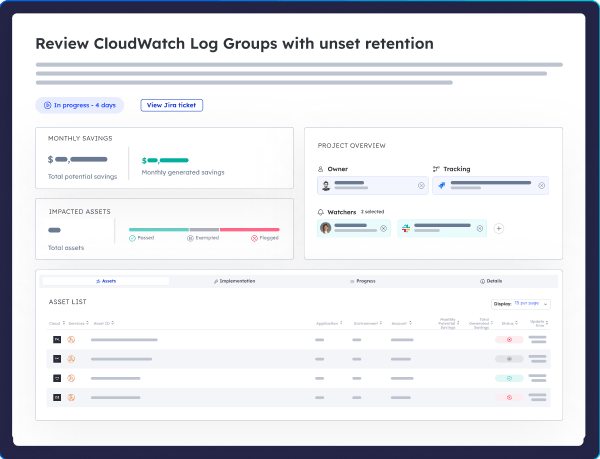
For engineering teams, the distinction that matters most is whether a tool produces reports or drives accountable action. Cloud ex Machina (CxM) is built for the second category: it infers ownership without a manual tagging project, covers all three optimization levers in one system, and routes remediation as a proposed Jira ticket, GitHub pull request, or Slack alert instead of a standalone report.
|
Capability |
Visibility-Only Dashboard |
Workflow-Integrated Platform |
|
Attribution model |
Manual tagging required |
Automatic inference from deployment patterns, repos, permissions |
|
Workflow integration |
Reports in a separate interface |
Native delivery to GitHub, Jira, Slack |
|
Optimization levers |
Typically one or two |
Rate, Usage, and Configuration across the full stack |
|
Governance and policy enforcement |
Reporting on violations |
Policy definition, threshold automation, escalation paths |
|
Remediation automation |
Recommendations only |
AI-generated PRs, direct platform execution, automated ticketing |
|
Audit trail |
Spend history and anomaly logs |
Remediation history, exception records, KPI progress documentation |
Cloud ex Machina (CxM) is built around the right column of this table.
Here are some important questions that you can ask:
- Does the tool live inside existing engineering workflows?
- Does it handle attribution without a manual tagging project?
- Does it support spend policy enforcement rather than just reporting?
- Does it cover all three optimization levers in a unified system?
- Does it close the loop with verified results and documented exceptions?

Getting Started with Cloud Financial Operations
Moving from ad hoc cost management to a structured cloud FinOps program follows a sequence. Governance infrastructure first, optimization targeting second. Most programs fail because they invert this, setting cost reduction targets before the ownership and policy structures are in place to make those targets achievable.
- Connect your cloud environment with read-only API access across AWS, Azure, or GCP. The goal is a single view that cuts across accounts, regions, services, and environments simultaneously. Don't skip multi-environment coverage: staging and development are consistent sources of undetected waste.
- Establish resource ownership through automatic attribution or an initial attribution baseline. Whether you build that baseline manually or automate it from day one, the requirement is the same: every significant resource needs a resolvable owner before you start routing remediation work. Flag unattributed spend explicitly rather than letting it disappear into a catch-all bucket.
- Define your spend policies. Policies are the rules your environment is expected to follow. Without them, every anomaly requires a judgment call, and at scale, judgment calls don't happen. Define provisioning standards, idle resource thresholds, commitment coverage requirements, and the escalation paths that activate when those policies are breached. A threshold with no defined response is just a metric. Share these with engineering leads before optimization work begins so remediation isn't a surprise.
- Set measurable targets aligned to business objectives. Targets need a metric, a magnitude, a timeframe, and an environment scope. "Reduce cloud costs" isn't a target. "Reduce idle resource spend by 30% over the next quarter in staging, tracked against a current baseline" is. Frame each target as a project with a defined owner and a KPI that shows progress. That's what separates optimization programs that ship from programs that stall.
- Prioritize by lever based on where your environment's waste profile is most concentrated. Don't assume the distribution: run a lever analysis before sequencing remediation work. In some environments, configuration problems dominate. In others, usage waste leads. Rate optimization through Reserved Instances and Savings Plans delivers predictable returns but requires stable usage baselines first. Let your actual spend data determine where you start.
- Route remediation through existing engineering workflows. Jira tickets with automatic ownership assignment, Slack alerts tied to the responsible team, and AI-generated pull requests for infrastructure changes reduce the friction between identifying an opportunity and acting on it. The closer remediation is to where engineers already work, the shorter the path to a verified outcome.
From Cloud Visibility to Governed, Measurable Action
Cloud FinOps has a visibility problem and an action problem. The visibility problem is largely solved. The action problem persists because most implementations stop at reporting and don't build the governance layer that connects insights to accountability.
The organizations that close the visibility-to-action gap establish ownership before setting targets, define spend policies before measuring compliance, and route remediation through the tools engineers already use. They treat optimization as a project with measurable targets and verified outcomes, not as a continuous process of finding and reporting waste.
Cloud ex Machina (CxM) is built to close that gap. By automatically inferring resource ownership, connecting optimization across all three levers, and proposing AI-generated remediation, ready to route as a Jira ticket, GitHub pull request, or Slack alert for the owning engineer to act on, CxM gives engineering teams the governance infrastructure and execution pathways that turn visibility into verified outcomes. See how it works by booking a demo with us today.