
Cloud infrastructure has revolutionized deployment speed, but it has also introduced a financial complexity that traditional cloud cost management strategies struggle to address. With cloud spend projected to grow significantly and waste persisting despite the abundance of visibility tools, the challenge has shifted from simply tracking costs to actively managing them within the engineering lifecycle.
This guide provides a developer-first framework for closing the gap between cost insight and engineering action, transforming optimization from a reactive chore into a proactive discipline.
Key Takeaways
- The Execution Gap: Why visibility tools surface symptoms but fail to provide the context needed for remediation.
- Automated Attribution: How to map ownership dynamically without relying on brittle manual tagging strategies.
- Workflow-Native Action: Integrating cost optimization directly into PRs, CI/CD pipelines, and daily engineering tools.
- The Three Optimization Levers: Mastering Usage, Configuration, and Rate to drive holistic efficiency.
- Governance as Guardrails: Implementing automated checks that prevent waste before code merges.
Why Cloud Cost Management Is Essential in Modern Cloud Environments
With cloud spend projected to rise 28% and 84% of organizations struggling to control costs, the focus must shift from simple migration to efficient operation. Waste currently sits at roughly 30% because deployment speed often outpaces governance. Effective cost management is now a critical engineering discipline essential for maintaining agility without accruing technical and financial debt.
Cloud Spend Growth & Complexity
As engineering teams embrace microservices, Kubernetes, and multi-account architectures, the bill becomes as complex as the infrastructure itself. Modern applications rely on a web of managed services, creating hidden costs that often escape basic monitoring:
- Unattached storage volumes and forgotten snapshots.
- Expensive data egress charges.
- Abstracted Kubernetes layers (pods/nodes) that make linking dollars to features difficult.
Understanding the true cost of a feature now requires deep architectural context rather than just a monthly invoice.
The Visibility-to-Action Gap
While the industry has flooded teams with dashboards, visibility does not equal remediation. Reporting tools often act as sophisticated spectators, surfacing symptoms like spend spikes without the context needed to solve them. Alerts frequently trigger investigation rabbit holes rather than action, leaving engineers asking critical questions:
- Who owns this resource?
- Is it actually idle or a failover node?
- Is it safe to shut down?
Closing this gap requires systems that automatically map infrastructure to ownership without relying on brittle manual tagging, delivering scoped, safe recommendations directly to code owners.
Cloud Cost Management as an Engineering Enabler
Reframing cost management as an engineering constraint unlocks operational value. Eliminating bloated infrastructure reduces operational noise and the incident surface area, directly improving reliability.
Instead of treating optimization as a disruptive quarterly cleanup project, it becomes a continuous engineering habit. Integrating cost checks into the CI/CD pipeline aligns architectural decisions with business goals and transforms cost into a metric of software quality.
Cloud Cost Visibility & Allocation

Raw billing data is rarely enough to drive efficient habits. Teams also need a unified view that translates abstract billing lines into engineering reality.
1. Unified Cloud Cost Visibility
Modern infrastructure spans multiple environments, accounts, and clusters. True visibility requires consolidating these disparate signals into a "single pane of glass". This view must drill down to specific workloads, namespaces, and repositories, connecting data to organizational context so teams can trace costs back to specific features rather than aggregate line items.
2. Accurate Cloud Cost Allocation
Traditional manual tagging strategies almost invariably break at scale due to maintenance burdens and rapid deployments. A developer-first approach replaces this with automatic attribution.
|
Approach |
Mechanism |
Outcome |
|
Manual Tagging |
Requires strict enforcement; tags go stale as services evolve. |
Attribution gaps where "unallocated" spend grows and ownership obscures. |
|
Automated Attribution |
Analyzes deployment patterns, Git history, and IAM roles. |
Builds a "living social graph" of ownership without tagging toil. |
Automated mapping ensures every anomaly routes to the correct team, reducing false positives and delivering scoped remediation tasks directly to the engineers best positioned to act.
This is the core of how Cloud ex Machina (CxM) works: it builds the ownership map automatically, inferring owners from deployment patterns, Git history, and IAM roles rather than tags, so every cost anomaly is attributed to the team that owns the workload, even where tag coverage is incomplete.

Cloud Cost Control & Governance
In the race to ship features, cloud governance often feels like a brake pedal. Traditional models rely on gatekeepers—finance reviews, approval committees, and rigid procurement processes—that slow down development cycles. However, modern cloud cost control shouldn’t stop engineers from provisioning resources, just provide the guardrails that allow them to move fast without breaking the budget. Effective governance shifts the focus from policing spend to automating the decisions that lead to efficiency.
1. Guardrails Instead of Roadblocks
The most effective way to manage cloud costs is to prevent waste before it ever reaches production. Waiting for a bill to arrive before identifying an expensive misconfiguration is a failure of process. By implementing pre-merge cost checks, organizations can catch costly architectural decisions at the pull request (PR) stage, long before resources are provisioned.
Just as a CI/CD pipeline runs unit tests and security scans, it should also run cost estimation checks. If an engineer inadvertently increases the instance size of a fleet of servers by 4x, the system should flag this immediately, offering a comparison of the projected cost versus the budget impact. This doesn't necessarily block the deployment, but it forces a moment of intentionality. The engineer must acknowledge the cost impact or adjust the configuration. This reinforces daily engineering habits, where cost becomes a standard consideration alongside performance and security, rather than an afterthought addressed during a monthly "cleanup day". This matters more now that AI coding agents (Claude Code, Amazon Q, GitHub Copilot, Cursor) are generating infrastructure-as-code at volume, often producing more PRs than human review can keep pace with. Cost and compliance checks have to shift left into the PR itself, or agent-authored changes bypass governance entirely.
2. Governance Through Automation
Manual policy enforcement is a losing battle in dynamic cloud environments. Relying on humans to remember to tag resources, set retention policies, or choose the optimal storage tier ensures inconsistent results. Governance through automation replaces human vigilance with codified rules that run continuously in the background.
Automated governance tools can scan the environment for policy violations and, in many cases, remediate them automatically. For example:
- Storage Policies: If a development S3 bucket is created without a lifecycle policy, an automated rule can apply a default policy that transitions objects to cheaper storage classes after 30 days.
- Resource Scheduling: If an expensive database instance is provisioned in a sandbox environment, automation can flag it for review or auto-terminate it after business hours.
This approach ensures compliance with cost policies without requiring engineers to memorize a rulebook, reducing the cognitive load on development teams while maintaining financial hygiene.
3. Budget Awareness for Engineering Teams
Budget overruns often occur because engineers have no visibility into cost control. When budget data is locked away in finance spreadsheets, engineering teams operate in a vacuum, unaware of how their technical decisions impact the bottom line. Bringing budget awareness directly to engineering teams changes this dynamic.
Budget tracking needs to be granular and role-specific. An individual contributor doesn't need to see the entire organization's cloud spend, but they should know if their specific service is trending 20% over its forecasted budget, for example.
|
Role |
Visibility Need |
|
Team Leads |
Visibility into specific projects and service-level budgets. |
|
FinOps Practitioners |
Broader portfolio views and compliance tracking. |
|
Executives |
High-level trends and ROI alignment. |
By connecting specific services and infrastructure decisions to their budget impact, organizations empower engineers to take ownership. When a team sees that they are approaching their budget limit, they can proactively prioritize optimization tasks—such as rightsizing instances or cleaning up old snapshots—ensuring that fiscal responsibility is distributed rather than centralized.
Cloud Cost Optimization Across Three Levers
Optimization is often treated as a singular activity, but in practice, it operates across three distinct levers: Usage, Configuration, and Rate. A comprehensive cloud cost management strategy must pull all three levers simultaneously to achieve maximum efficiency. Focusing on just one—like buying commitments—without addressing the others—like idle resources—results in a partially optimized environment that still leaks money. Sequence matters: eliminate waste and rightsize first, then commit, buying commitments before you've cleaned up locks in waste at a discount.
1. Usage Optimization (Reducing Waste)
Usage optimization is the operational lever: ensuring you only pay for what you actually need. This is the most direct way engineers can influence the cloud bill, as it involves the physical removal or resizing of infrastructure. The cloud's pay-for-what-you-use model only works if you stop using what you don't need.
The primary targets for usage optimization include:
- Rightsizing Compute: Matching instance types and sizes to the actual performance requirements of the application.
- “Zombie” Infrastructure: Eliminating orphaned EBS volumes, unattached elastic IPs, and old snapshots.
- Container Efficiency: Adjusting CPU and RAM reservations in containerized environments to match consumption.
- Autoscaling: Ensuring infrastructure scales down aggressively during periods of low demand.
2. Configuration Optimization (Fixing Inefficient Patterns)
Configuration optimization is the architectural lever. It involves changing how resources are used and configured to maximize efficiency. This is often the most overlooked lever because it requires deep knowledge of cloud services and their pricing models.
Simple configuration changes can yield massive savings. For example:
- Storage Tiering: Moving data to Intelligent Tiering classes to cut storage costs with zero performance impact.
- Retention Policies: Adjusting log retention from "forever" to "30 days" for data that is rarely accessed.
- Drift Detection: Identifying and repairing configuration drift across cloud and Kubernetes environments.
3. Rate Optimization (Commitments & Discounts)
Rate optimization is the financial lever of cloud cost management. It involves paying less for the resources you use through mechanisms like Reserved Instances (RIs) and Savings Plans (SPs). While this seems purely financial, it requires deep technical insight to execute effectively without overcommitting.
Effective rate optimization relies on analyzing real usage signals rather than static baselines. A common pitfall is purchasing commitments based on peak usage, leading to wasted spend during off-peak hours. Instead, organizations should:
- Analyze Historical Patterns: Determine the stable "base load" of applications to avoid overcommitting.
- Automate Execution: Automate the analysis and recommendation of purchases and renewals, and gate the actual commitment behind an approval, so coverage stays current without locking in spend blindly.
By treating commitments as a portfolio that needs active management, organizations can secure significant discounts while matching flexibility to the workload. The most flexible commitments, AWS Compute Savings Plans, reduce costs by up to 66% while letting you change instance families and regions, and even shift usage to Fargate or Lambda. Locking to a single instance family and region (EC2 Instance Savings Plans or Standard Reserved Instances) trades that flexibility for a deeper discount, up to 72%.
At the infrastructure code level, engineers can submit Infrastructure as Code (IaC) pull requests to enforce these best practices.
Cloud Cost Management Best Practices

Implementing a successful cloud cost management strategy requires a shift in how teams operate, including which tools they use. Best practices in this space focus on reducing friction, increasing visibility, and making optimization a natural part of the engineering workflow.
Improve Cloud Cost Visibility Across the Organization
Visibility must be democratized. Keeping cost data siloed in the finance department ensures that the people creating the costs—the engineers—remain blind to them. Organizations should replace static, monthly reports with real-time, contextualized views that are accessible to everyone.
This means integrating cost information directly into the platforms where work happens. A developer shouldn't have to log into a separate billing console to see the cost of their service. That data should be visible in their deployment tools, their monitoring dashboards, and their project management software. When cost data is ubiquitous and transparent, it removes the mystery behind the cloud bill and enables informed decision-making at every level of the organization.
Build Cost-Aware Engineering Habits
The goal is not to force engineers to become accountants, but to help them develop habits that naturally lead to efficiency. This is distinct from trying to force a vague culture change, which often feels top-down and abstract. Instead, focus on specific, repeatable behaviors.
Encourage developers to adopt cost-efficient patterns in their daily work:
- PR Cost Checks: Reviewing the estimated cost impact of a pull request before merging.
- Scheduled Cleanup: Setting up scripts to remove temporary resources automatically.
- Efficient Defaults: Choosing efficient default configurations for new services.
Over time, these small, habitual actions compound into significant savings. It is important to frame these habits around reliability and quality rather than just cost cutting. Clean code is efficient code; a lean environment is a stable environment. By avoiding cost culture messaging and focusing on engineering excellence, organizations can drive adoption without resistance.
Automate Cloud Cost Optimization
Manual optimization is unscalable. Asking engineers to constantly comb through lists of idle instances is a recipe for burnout and neglect. Automation is the only way to keep pace with the dynamic nature of the cloud.
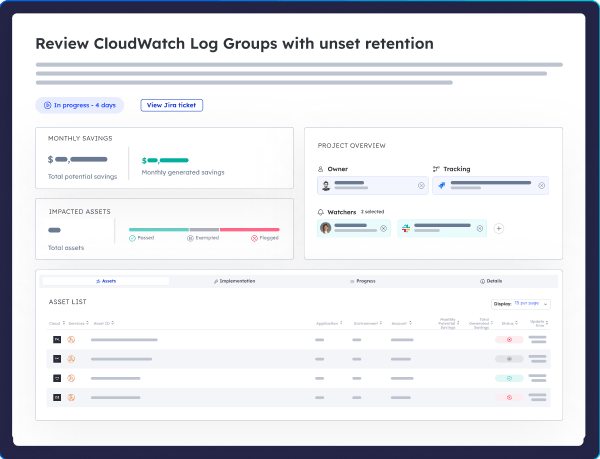
Automation should turn to-do lists into actual remediations. Instead of generating a ticket that says "Resize this instance," the system should generate a pull request with the necessary code changes, ready for review. Rather than pushing changes on its own, CxM proposes a scoped plan, with the mechanism, impact, and owner, that can translate directly into a Jira ticket or a Terraform pull request for the owning engineer to review and merge. Unlike dashboards that stop at a recommendation, the fix arrives where the work already happens. For lower-risk actions, such as deleting old development snapshots, automation can handle the execution entirely. This reduces the human toil involved in cost management and increases trust in the optimization process. When engineers see that automation reliably identifies and fixes waste without breaking production, they become more willing to adopt aggressive optimization strategies.
Establish Shared KPIs for Optimization Efforts
You cannot improve what you do not measure. Establishing shared Key Performance Indicators (KPIs) for optimization aligns engineering and finance teams around common goals. These metrics should go beyond simple total spend figures, which can be misleading in a growing company.
Effective KPIs focus on efficiency and waste reduction:
- Idle Resource Reduction %: Tracks the elimination of unused assets.
- Commitment Utilization Rate: Measures how effectively discounts are being applied.
- Effective Savings Rate (ESR): Combines discounts and usage optimization into a single efficiency score.
Organizations should use closed-loop verification to prove the impact of these efforts. Tracking the before and after cost of specific interventions validates the work and demonstrates the tangible business value of engineering optimization efforts.
Connect Cost Insights With Engineering Ownership
The fastest way to kill an optimization initiative is to send recommendations to the wrong people. Broadcasting a list of 100 idle instances to the entire engineering department creates noise and diffusion of responsibility. Everyone assumes someone else is handling it, and ultimately, no one does.
Insights must be delivered directly to the specific team or individual who owns the resource. This requires a robust ownership mapping strategy that connects cloud assets to service owners. When an alert about an expensive query arrives directly in the inbox of the database engineer who wrote it, action is far more likely. This targeted approach prevents cross-team thrash, where teams waste time investigating resources they don't own, and ensures that remediation is handled by the people with the context to do it safely.
Get more insight into the importance of visibility with our latest whitepaper: Closing the Workflow Gap in Cloud Cost Management
[ebook-callout-1]
Cloud Cost Management for Enterprises
Enterprise environments present unique challenges that smaller startups don't face. The sheer scale of infrastructure, combined with complex organizational structures and strict compliance requirements, demands a more robust approach to cost management.
Multi-Cloud & Large-Scale Environments
Enterprises rarely operate in a single cloud account. They manage complex hierarchies of accounts, subscriptions, and projects across AWS, Azure, and Google Cloud. With thousands of resources and hundreds of engineering teams, manual tracking is impossible.
In these environments, automatic ownership inference becomes essential. The system must be able to ingest data from multiple cloud providers and normalize it into a unified view. It needs to navigate complex tagging schemas—or the lack thereof—to accurately attribute costs to business units. A unified governance layer is required to enforce policies consistently across different providers, ensuring that a storage policy defined for AWS S3 is also applied to Azure Blob Storage. This abstraction allows the enterprise to manage cost strategy centrally while executing it across a heterogeneous landscape.
Enterprise-Grade Security & Compliance
For large organizations, security is paramount. Any tool that touches cloud infrastructure must adhere to strict security standards. Cost management platforms should operate on a least privilege model, typically requiring only read-only access to billing data and metadata for analysis.
However, for automated remediation, permission boundaries must be carefully defined. Enterprise-grade solutions often utilize cross-account IAM roles with explicit constraints, ensuring that an optimization tool can resize an instance but cannot access the data stored within it.
Key security features include:
- Identity Mapping: Linking actions to authenticated users via SSO providers like Okta to ensure accountability.
- Audit Trails: Clear logging of every action taken by the system, whether a recommendation generated or a resource terminated.
Aligning Cloud Cost Management With Business Outcomes
At the enterprise level, cloud cost is a driver of gross margin and profitability. Cost management strategies must align with broader business outcomes. This means moving the conversation from "How much did we spend on servers?" to "What is our cost per customer?" or "What is the infrastructure cost of this new product feature?"
KPIs effectively connect engineering work to financial impact. For example, when engineering leaders can demonstrate that a 10% increase in cloud spend supported a 50% increase in user traffic, the conversation shifts from cost-cutting to efficient scaling. This visibility allows executives to track optimization progress across the entire portfolio, identifying which business units are operating efficiently and which need support. Predictable budgets, driven by accurate forecasting and variance analysis, strengthen financial planning and prevent the quarterly surprises that erode trust between engineering and finance.
Reducing Organizational Friction Around Cloud Costs
Friction is the enemy of execution. In many enterprises, the relationship between FinOps and engineering is adversarial: Finance demands savings, and Engineering defends its need for resources. A developer-first cost management approach reduces this friction by aligning incentives.
|
Role |
Benefit of Frictionless Cost Management |
|
Engineers |
Receive clear, scoped work rather than vague mandates. |
|
FinOps Teams |
Gain reliable execution of strategies without nagging engineers. |
|
Executives |
Gain measurable ROI and clarity on spending. |
By streamlining the process of identifying, assigning, and resolving cost issues, organizations transform cost management from a source of conflict into a collaborative operational practice.
How to Get Started With Cloud Cost Management

Implementing a robust cloud cost management strategy doesn't happen overnight, but taking the first steps is straightforward. The key is to start with visibility and move quickly toward automated action.
1. Connect Your Cloud Accounts
The first step is ingestion. Connect your cloud providers—AWS, Azure, and GCP—to your cost management platform. This typically involves setting up a read-only integration that allows the system to ingest Cost and Usage Reports (CUR), billing data, and resource metadata. Modern platforms allow for multi-cloud ingestion, providing a single, consolidated view of your entire digital estate within minutes.
2. Map Ownership Automatically
Once the data is flowing, the next challenge is making sense of it. Resist the urge to launch a massive manual tagging project. Instead, leverage tools that offer automated inference. By connecting to your deployment pipelines, code repositories, and identity providers, you can build a dynamic ownership graph. This maps resources to the teams that actually deployed them, filling in the gaps left by missing or inconsistent tags.
3. Establish Optimization Projects & KPIs
Don't try to boil the ocean. Define tangible, time-bound goals for your optimization efforts. Start with a focused project, such as "Reduce idle development resources by 20% in Q1". Establish KPIs to track progress, prioritizing opportunities based on their potential impact and the confidence level of the recommendation. This focused approach generates quick wins and builds momentum for broader initiatives.
4. Start Automating Remediation
Move from observation to intervention. Enable automation for low-risk tasks first.
- Config Changes: Configure the system to generate pull requests for configuration changes, such as applying lifecycle policies or rightsizing stateless workloads.
- Rate Optimization: Automate the execution of rate optimizations to ensure your commitment portfolio stays healthy.
- Operational Tasks: For operational tasks that require human judgment, ensure they are delivered to Jira or Slack with full context, making it easy for engineers to say "yes" to savings.
5. Monitor, Verify, and Iterate
Cloud cost management is a continuous loop, not a destination. Use closed-loop verification to measure the actual savings realized from your actions against your initial projections. Reassess your commitment portfolio quarterly to adjust for changes in usage patterns. Continuously refine your policies and automation rules to build better engineering habits. As the organization matures, cost efficiency will transition from a project to a standard operating procedure.
Conclusion
Cloud cost management is about closing the gap between visibility and action. As cloud environments grow in complexity, the traditional methods of manual reporting and reactive cleanup are failing. The solution lies in a developer-first approach that respects the engineering workflow.
By integrating cost intelligence directly into the tools developers use, automating the tedious work of attribution and governance, and empowering teams with safe, scoped remediation paths, organizations can turn the tide on cloud waste. It is time to stop chasing cost alerts and start engineering a more efficient cloud.
Stop chasing cost alerts. Start fixing them. Request a demo of CxM today.