
Modern cloud infrastructure is no longer just a place to host code or store data. It is a foundation for how engineering teams deliver value, how organizations scale, and how economic decisions compound over time. Cloud architecture defines how compute, storage, networking, identity, and software services are assembled into an environment that reliably supports growth without introducing hidden operational or financial debt.
At the end of the day, cloud architecture is a delivery system. Every architectural choice—instance families, storage defaults, network topology, deployment patterns—creates long-lived consequences for cost, reliability, and engineering velocity. Teams that treat architecture as a static diagram quickly discover that technical correctness alone does not guarantee efficiency. Teams that design architecture for ownership, execution, and continuous correction build systems that remain lean as they scale.
Key Takeaways
- Architecture is an Economic System: Cloud architecture choices are financial commitments. Defaults compound silently unless teams design for continuous correction.
- Execution Beats Visibility: Dashboards explain what happened. Architecture designed for workflow-native execution prevents waste before it ships.
- Ownership Is Architectural, Not Administrative: If resources cannot be automatically attributed to teams, optimization stalls regardless of tooling.
- Efficiency is a Habit, Not a Project: Sustainable optimization emerges from daily engineering habits embedded into CI/CD, not quarterly cleanup efforts.
What is Cloud Architecture?

Cloud architecture is the structural design of a cloud computing environment—how infrastructure, platforms, and services interact to deliver applications at scale. It defines how front-end interfaces connect to back-end systems, how workloads are deployed and isolated, and how resources are provisioned, secured, and observed.
More importantly, cloud architecture establishes how decisions flow:
- Who can deploy resources
- How those resources are governed
- How cost, performance, and reliability signals return to the people who can act on them
In well-designed environments, architecture makes the right action the easy action. In poorly designed ones, inefficiency becomes invisible until it appears on a monthly bill.
The Shift from Hardware-Centric Data Centers
Traditional data centers treated infrastructure as a fixed asset. Capacity planning was manual, provisioning was slow, and costs were largely predictable because change itself was expensive.
Cloud architecture replaced this model with abstraction:
- Virtualized compute and storage
- On-demand provisioning
- Infrastructure defined in code
This shift unlocked speed and scale, but it also introduced a new failure mode: invisible accumulation. Resources can be created instantly, duplicated effortlessly, and forgotten just as quickly. Without architectural guardrails, efficiency decays silently.
The Hidden Challenge: The Cost Paradox
Despite mature cloud platforms and widespread adoption of architectural best practices, most organizations still struggle to control cloud spend. 84% of organizations continue to struggle with cloud costs even after adopting modern architectural patterns.
This paradox occurs because traditional architecture focuses on visibility and reporting rather than delivery and implementation:
- Cost dashboards
- Monthly reports
- Retrospective analysis
While teams can view their cloud spend on dashboards, they often lack the workflow-native tools required to stop waste where it starts—at the engineering level. The paradox is not a lack of data—it is a lack of execution.
Visibility vs. Execution
|
Visibility-First Architecture |
Execution-Ready Architecture |
|
Dashboards after the fact |
Signals before deployment |
|
Reports owned by finance |
Actions owned by engineers |
|
Manual triage |
Automated remediation paths |
|
Cost awareness |
KPI-driven delivery |
Until architecture supports execution, optimization remains reactive and perpetually deprioritized.
Foundations of Cloud Architecture: Components and Principles
A robust cloud architecture aligns technical layers with ownership and action.
Front-End and Back-End Platforms
The front end provides user access to applications, dashboards, and APIs. The back end delivers execution and persistence through several layers:
- Applications: Business logic and services delivering user functionality.
- Services: Managed platforms for compute, storage, databases, messaging, and analytics.
- Cloud Runtime: The execution environment: operating systems, containers, memory, and hardware abstraction.
- Management and Control Plane: Identity systems, deployment tooling, policy engines, and orchestration layers that determine who can act and how changes flow.
- Security: Authentication, authorization, encryption, and network isolation are embedded directly into the architecture.
- Infrastructure: The physical hardware—servers, CPUs, GPUs, networking—that ultimately powers the system.
Architectures that treat management and identity as first-class components enable automatic ownership inference. Architectures that ignore them rely on brittle manual processes that fail at scale.
Cloud Architecture Principles That Enable Execution
Modern cloud architecture must actively enable execution—making it easy for engineers to detect inefficiencies, safely remediate them, and verify impact. Architectures that fail to account for human workflows inevitably drift toward waste, regardless of how well they score on paper.
The following principles extend traditional cloud best practices by focusing on actionability, ownership, and continuous correction.
Failure and Self-Healing
Resilience remains foundational, but self-healing must extend beyond uptime. In execution-ready architectures, systems should recover not only from outages but also from inefficient states.
Examples include:
- Auto-scaling groups that correct sustained underutilization, not just traffic spikes
- Storage lifecycle policies that transition or expire unused data automatically
- Kubernetes controllers that detect and reconcile oversized resource requests
This principle reduces both reliability risk and cost debt. When systems self-correct, engineers spend less time firefighting and more time improving the platform.
Decouple Components to Enable Independent Optimization
Decoupling is often discussed in terms of scalability, but its execution impact is just as critical. When components are tightly coupled, optimization becomes risky because changes have an unpredictable blast radius.
Execution-ready architectures:
- Isolate workloads by service, environment, and criticality
- Separate shared infrastructure from team-owned resources
- Avoid monolithic clusters where ownership is ambiguous
Decoupling enables targeted remediation. Engineers can confidently adjust instance types, storage classes, or scaling policies for a single service without triggering cross-team coordination overhead.
Ownership by Default
Ownership is not a reporting concern—it is an architectural concern. If a resource cannot be unambiguously attributed to a team, optimization stalls regardless of tooling or intent.
Execution-ready architectures embed ownership signals directly into:
- Deployment pipelines (who shipped it)
- Identity systems (who can change it)
- Repository structure (where its configuration lives)
- Runtime metadata (which service or namespace it belongs to)
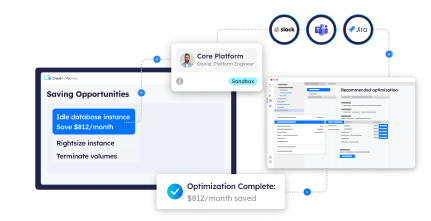
This eliminates dependence on manual tagging initiatives, which consistently fail at scale. When ownership is inferred automatically from how systems are built and deployed, accountability becomes continuous and frictionless. Cloud ex Machina (CxM) infers ownership from deployment pipelines, identity, and repository structure. No manual tagging is required. So optimization tasks route to the team that owns the service.

Reversibility and Low-Risk Change
Many architectural inefficiencies persist because teams are afraid to touch them. Reversibility addresses this by making changes safe, testable, and easy to roll back.
Key practices include:
- Infrastructure as Code for all mutable resources
- Versioned configuration with peer review
- Progressive rollout and canary strategies
- Clear separation between configuration changes and application logic
When remediation can be delivered as a pull request rather than a manual intervention, optimization competes less with feature delivery and is more likely to ship.
Continuous Correction, Not Periodic Cleanup
Traditional architectures assume optimization happens in cycles: review, analyze, and fix. Execution-ready architectures assume optimization is continuous. CxM proposes remediations as pull requests tied to deployment events, not monthly invoices.
This requires:
- Signals delivered as they happen, not batched into a monthly invoice.
- Thresholds and policies that surface issues early
- Automated pathways from detection to remediation
- Verification loops that confirm impact against defined KPIs
Instead of asking, “What did we overspend last month?”, teams can answer, “What inefficient decision did we just prevent from reaching production?”
KPI Alignment, Not Just Cost Reduction
Optimization without targets devolves into busywork. Execution-ready architecture connects technical actions to explicit business objectives.
Examples include:
- Reducing idle capacity as a percentage of total spend
- Improving resource utilization per environment
- Stabilizing unit cost per customer or request
- Increasing coverage of automatically attributed resources
Architectures that surface these signals continuously allow teams to prioritize work based on impact, not intuition. Engineers can see how a configuration change contributes to measurable outcomes, reinforcing efficient habits.
Workflow-Native Feedback
Finally, execution depends on where feedback appears. Architecture should deliver signals into the tools engineers already use—not force context switching.
This means:
- Cost and efficiency signals tied to commits and deployments
- Remediation surfaced in version control and ticketing systems
- Clear ownership embedded in the delivery path
When feedback arrives inside the workflow, optimization becomes part of how work gets done rather than an external interruption.
In practice, these principles transform cloud architecture from a static blueprint into a living system—one that continuously guides teams toward efficient decisions. Architectures that enable execution do not rely on heroics or quarterly initiatives. They encode good habits directly into the platform, ensuring efficiency scales alongside the business.
Cloud Architecture Optimization: From Cleanup to Habit
True optimization is not a quarterly exercise. It is the natural byproduct of daily engineering work.
Reactive rightsizing fixes yesterday’s problems. Execution-ready architecture enables pre-deployment correction, where inefficient configurations are identified and resolved before they reach production.
In mature environments:
- Architectural decisions generate cost and performance signals.
- Signals map automatically to owners.
- Remediation paths are delivered through Git, CI/CD, or ticketing systems.
- Outcomes are verified against defined KPIs.
Optimization becomes part of delivery—not an interruption to it.
Exploring Types of Cloud Architecture

Organizations choose different deployment models based on their specific needs for control, scalability, and cost optimization.
|
Architecture Type |
Description |
Key Benefit |
|
Public Cloud |
Resources owned and operated by a third-party provider over the public internet. |
High scalability and reduced overhead through multi-tenant environments. |
|
Private Cloud |
Dedicated infrastructure owned and managed by a single organization, providing enhanced control. |
Maximum security and control over sensitive data and compliance requirements. |
|
Hybrid Cloud |
A mix of on-premises (private) and public cloud resources connected by a network. |
Flexibility to migrate workloads and keep sensitive data in a private setting while using the public cloud for burst capacity. |
|
Multi-Cloud |
Incorporating services from multiple cloud providers within the same IT infrastructure. |
Access to best-in-class offerings and avoidance of vendor lock-in. |
Public Cloud Architecture
Public cloud architecture leverages third-party providers like AWS, Azure, or GCP to manage the underlying physical hardware. This allows engineering teams to focus on building features rather than managing physical servers, utilizing subscription-based or pay-per-use resources. However, because it is a multi-tenant environment, organizations must be diligent about cost attribution to prevent wasted spend.
Private Cloud Architecture
Organizations with strict regulatory requirements or highly sensitive intellectual property often utilize private cloud architecture. These environments provide the highest level of data isolation and security control but typically require more internal engineering expertise to maintain and scale.
Hybrid Cloud Architecture
Hybrid cloud architecture is a design strategy that bridges private environments (on-premises) with public cloud environments. This model is particularly beneficial for companies transitioning legacy applications to the cloud or those needing to keep sensitive medical records or financial data in a private setting while using the public cloud for web hosting or content delivery.
Multi-Cloud Architecture
Multi-cloud architecture involves using multiple cloud providers simultaneously to gain access to specific services—such as using one provider for advanced AI capabilities and another for global networking reach. While this reduces vendor lock-in, it increases the challenge of managing complexity in a multi-cloud architecture environment. Establishing consistent multi-cloud architecture and governance are essential to maintain uniform security and cost policies across all providers.
What’s the Same and What’s Different: Navigating Cloud Models
While public, private, hybrid, and multi-cloud architectures all aim to abstract physical hardware to provide scalable compute and storage, they differ significantly in their operational overhead, security posture, and how they integrate into a developer’s daily habits.
Shared Fundamentals
- Virtualization: All models rely on an abstraction layer that divides physical hardware into virtual machines (VMs) or containers.
- Resource Pooling: Regardless of the deployment, resources are pooled to serve multiple applications or users, though the "tenancy" (shared vs. dedicated) changes.
- Networking Requirements: Every architecture requires a high-bandwidth, low-latency network to connect the front-end user interface with back-end services.
Key Differentiators
- Tenancy: Public cloud is multi-tenant, meaning you share hardware with others, whereas private cloud is single-tenant and dedicated to one organization.
- Maintenance: Public clouds offload hardware maintenance to the provider; private clouds require the organization to manage the server lifecycle and hardware refreshes.
- Cost Predictability: Public clouds offer a pay-as-you-go model that can lead to "surprise" bills, while private clouds involve high upfront capital expenditure (CapEx) but more predictable ongoing costs
Insights for Technical Stakeholders
Understanding these architectures is not just an academic exercise; it has direct implications for the specific roles responsible for building and scaling these systems.
For CTOs and VPs of Engineering
For executives focused on innovation and project delivery, the choice of architecture often comes down to time-to-market.
- Public Cloud: The preferred choice for scale-ups because it removes the "hardware bottleneck," allowing teams to ship features in hours rather than months.
- Habit Shift: Leaders must transition their teams from "hardware management" to "cost literacy." In a public cloud, a developer's habit of leaving a staging environment running 24/7 directly impacts the bottom line, making real-time visibility and automated ownership mapping essential.
For DevOps and Site Reliability Engineers (SREs)
DevOps teams are often the "heroes" caught in the workflow chasm, managing the complexity of multi-cloud environments.
- The Kubernetes Challenge: SREs managing Kubernetes across multiple clouds face unique hurdles in state management and networking.
- Remediation Habits: Rather than reactive rightsizing projects, SREs benefit from a delivery-native model where cost-saving recommendations—like switching instance types—arrive as automated pull requests in GitHub or GitLab. This embeds efficiency into the CI/CD pipeline rather than treating it as a post-mortem task.
For Finance Controllers and CFOs
Financial stakeholders often view cloud architecture through the lens of accountability and attribution.
- The Attribution Trap: In multi-cloud or hybrid environments, it is notoriously difficult to track which team owns which resource.
- Habitual Transparency: By utilizing an architecture that automatically maps resource ownership from day one, Finance can move from "guessing" costs to accurate unit economics. This shifts the relationship between finance and engineering from one of "nagging" to one of strategic alignment.
Provider-Specific Frameworks and Design
Every major cloud provider offers a specific blueprint for success, often illustrated through a detailed cloud architecture diagram.
|
Provider / Model |
Core Framework / Design Tool |
Key Focus Areas |
|
AWS |
AWS Well-Architected Framework |
Optimization across compute, storage, and networking. |
|
Azure |
Azure Architecture Diagram |
Integration with enterprise identity and management tools. |
|
GCP |
Google Cloud Well-Architected Framework |
Reliability, scale, and performance pillars. |
|
Kubernetes (Multi-Cloud) |
Workload Portability Design |
Orchestration, networking, and cross-cloud cost management. |
AWS Cloud Architecture
The AWS Well-Architected Framework provides a consistent set of principles for designing secure, high-performing systems. It is built on six pillars: operational excellence, security, reliability, performance efficiency, cost optimization, and sustainability.
Optimizing AWS cloud architecture involves fine-tuning resources based on real-time usage patterns captured in reports like the Cost and Usage Report (CUR). Engineering teams often utilize AWS CloudFormation or Terraform to automate the deployment of these designs, ensuring that the final infrastructure matches the initial cloud architecture diagram. A key habit for AWS-centric teams is the periodic review of architectural choices against the latest instance types and storage classes to prevent legacy inefficiencies from accumulating.
Azure Cloud Architecture
A typical Azure cloud architecture diagram focuses on integration with enterprise identity tools like Okta and Microsoft Entra ID (formerly Azure Active Directory). Azure's design often prioritizes seamless connectivity between on-premises enterprise environments and the cloud, making it a primary choice for hybrid cloud architecture.
The Azure Well-Architected Framework guides teams through five pillars: reliability, security, cost optimization, operational excellence, and performance efficiency. For teams scaling on Azure, the primary goal is ensuring that resource tagging and governance policies are enforced at the subscription level. Developing habits around the use of Azure Advisor can help teams identify low-hanging fruit in cost and security, though proactive engineering still requires shifting these insights directly into the developer's pull request workflow.
Google Cloud Architecture
The Google Cloud Well-Architected Framework (formerly the Architecture Framework) emphasizes reliability and scale, drawing on Google's extensive experience with massive-scale data systems. By analyzing framework pillars—such as operational excellence, cost optimization, and security—teams can build systems that leverage advanced data and AI services.
GCP’s design philosophy often centers on open-source compatibility, particularly with Kubernetes, which was originally developed at Google. Architecting for GCP requires a deep understanding of project hierarchies and the Billing Export API, which feeds raw data into BigQuery for advanced analysis. For developers, this means building habits around granular service accounts and project-level isolation to ensure that every dollar of cloud spend is attributed to the correct workload or team.
Kubernetes Multi-Cloud Architecture
Orchestrating containers across diverse environments requires a Kubernetes multi-cloud architecture. While powerful, it introduces Kubernetes multi-cloud architecture challenges related to networking, state management, and the high cost of data egress.
The goal of a multi-cloud Kubernetes design is to achieve workload portability, allowing services to move between AWS (EKS), Azure (AKS), and GCP (GKE) without significant code changes. However, this flexibility creates a "delivery gap" where cost and performance monitoring often become fragmented. Efficient teams bridge this gap by using a unified delivery layer that maps Kubernetes pod ownership back to the original engineering team, regardless of which cloud provider is currently hosting the cluster.
Bridging the "Workflow Chasm" in Design

A significant gap often exists between the theoretical design of a system and its actual performance in production.
The Problem with Traditional Design
A static cloud architecture diagram often fails to translate into an efficient production environment because it does not account for runtime behavior or the "human element" of development. Designs that look perfect on paper can become incredibly wasteful if resources are not mapped to owners or if they lack automated remediation paths.
The Role of Cloud Architecture Consulting
When seeking cloud architecture consulting, organizations should move beyond spreadsheets and toward implementation-ready guidance. Effective cloud architecture design services prioritize delivery over just visibility, ensuring that recommended changes are actually implemented by the engineering team.
Engineering Excellence: Training and Habits
Long-term architectural success depends on the skills and daily actions of the engineering team rather than periodic manual reviews.
Cloud Architecture Training and Courses
Developing "cost literacy" through cloud architecture training ensures that every developer understands how technical choices impact the bottom line. Top cloud architecture courses for modern DevOps teams now include modules on efficiency, resource ownership, and real-time management.
Developing Habits
Efficiency is not a one-time project; it is a habit. Engineering excellence involves shifting from reactive "cost projects" to building cost-conscious habits into every pull request. When cost data is delivered directly into tools like Slack, GitHub, or Jira, engineers can resolve inefficiencies as part of their standard workflow.
Conclusion
Cloud architecture is the foundation of digital innovation, but its true value is realized only when it is managed with a "developer-first" mindset. By moving beyond dashboards and embedding efficiency into daily engineering workflows, organizations can ensure their architecture remains lean, secure, and ready to scale. The workflow gap represents the greatest challenge in cloud cost management, but closing it transforms efficiency from a manual chore into a natural byproduct of excellent engineering.
Start optimizing your cloud costs today by integrating efficiency directly into your engineering flow. Book a demo with CxM today.