
Sections
Closing the Workflow Gap in Cloud Cost Management

Executive Summary

Although the cloud cost management industry is projected to reach $25.38 billion by 2032², organizations continue to overspend on unused cloud resources despite the high accessibility of cloud cost management tools:
The State of Cloud Cost in 2024 shows that only 30% of surveyed organizations could accurately track where their cloud budget was going³.
According to BCG, studies show that up to 30% of enterprise cloud spend is wasted due to inefficient usage and a lack of cost control; yet, remediation work often stalls because engineers lack the time to gather context and validate fixes.
With cloud spend expected to increase by 28% in the coming year¹, the problem is accelerating faster than traditional solutions can address it.
This whitepaper explains why visibility alone hasn’t solved cloud cost optimization, and introduces a fundamentally different approach. Instead of building more dashboards, we focus on embedding cost optimization directly into engineering workflows. Organizations that make this shift turn cost efficiency from a manual, reactive task into a natural outcome of everyday development.
A Preview of the CxM Approach
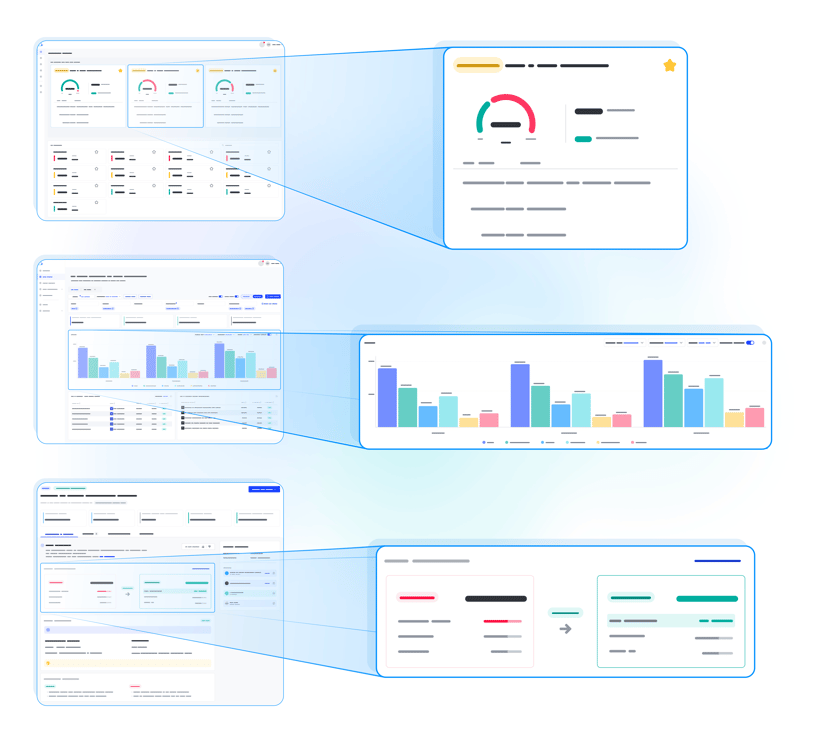
The chapters ahead trace the evolution of cloud cost management and reveal why, despite billions invested in visibility tools, cloud spend continues to be wasted. Cloud ex Machina (CxM) takes a different path, built on a simple truth: cloud cost management isn’t a visibility problem—it’s a delivery problem.
Engineers control the infrastructure decisions that shape spend, yet traditional FinOps tools operate in a separate universe of dashboards and monthly reports. The result is what we call sophisticated spectatorism: teams can describe their waste in detail but lack a practical way to remove it.
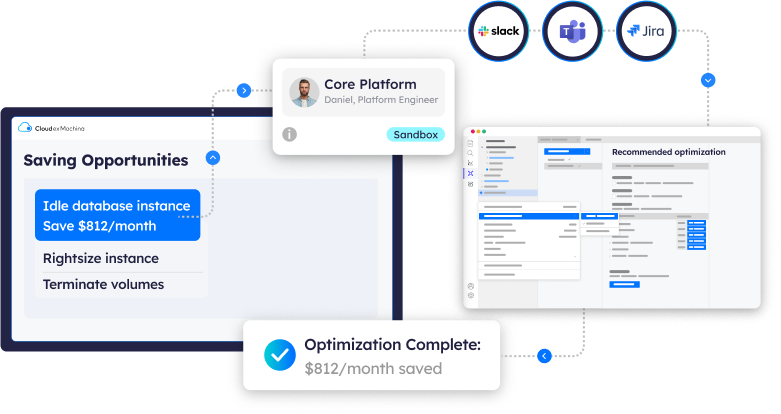
CxM closes this gap by treating cost optimization as engineering work. The platform continuously maps infrastructure, detects inefficiencies, and delivers implementation-ready fixes directly into existing workflows (e.g., GitHub pull requests, Slack alerts, and Jira tickets). There’s no tagging dependency, no finance-to-engineering translation, and no backlog delay. Engineers stay in control while the discovery and remediation work happens automatically.
The rest of this paper shows how this workflow-native model transforms cloud cost optimization from periodic clean-up projects to continuous, automated efficiency.

Chapter 1: When Visibility Failed Engineering
When Data Overload Replaced True Cloud Cost Control
The cloud cost management market has experienced explosive growth, with the global cloud cost management tools market size projected to reach USD 9.8 billion in 2024 and grow at a CAGR of 17.2% between 2025 and 2034⁴. This remarkable expansion reflects genuine organizational need and genuine organizational frustration.
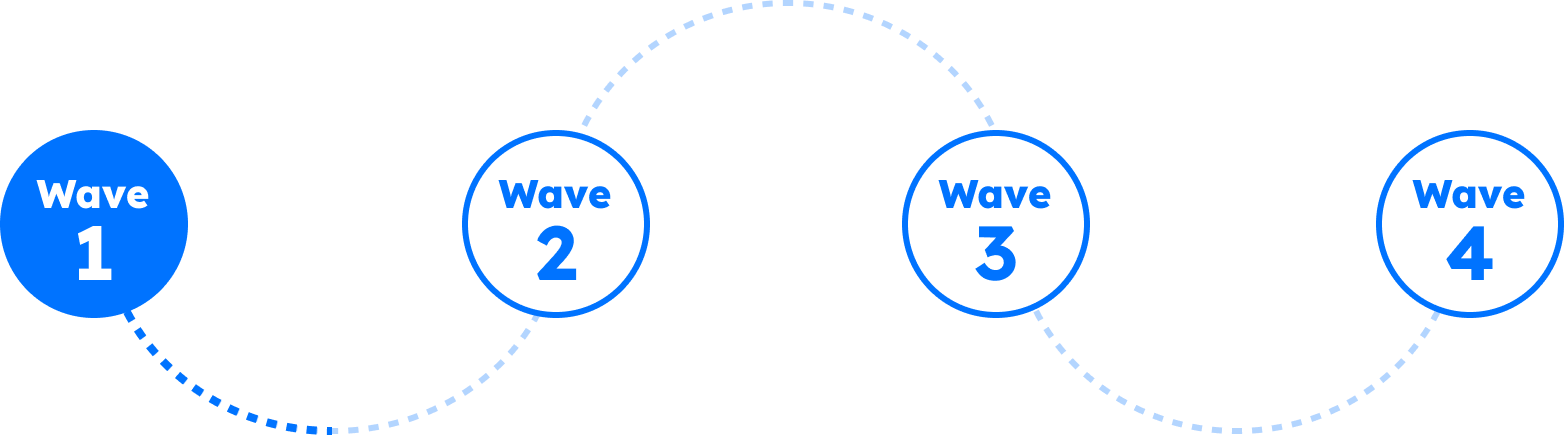
1 Wave 1: Independent Pioneers (2008–2013)
-1.png?width=419&height=246&name=Wave%201_%20Independent%20Pioneers%20(2008%E2%80%932013)-1.png)
Some third-party cloud management platforms even arrived before the hyperscalers’ own cost tools. Flexera, founded in 2008, grew from IT asset management into cloud cost governance. Cloudability followed in 2011, introducing one of the first FinOps-oriented platforms built around tagging, cost allocation, and governance frameworks.
While these tools gave finance and platform teams more precise cloud cost attribution than native consoles, they remained detached from day-to-day engineering. They revealed waste in rich detail, but rarely provided the operational context needed to fix it.
2 Wave 2: Native Provider Tools (2014+)
.png?width=419&height=246&name=Wave%202_Native%20Provider%20Tools%20(2014+).png)
The industry’s evolution continued with native cloud provider tools. AWS launched Cost Explorer in 2014⁵, providing the first systematic approach to understanding cloud spending patterns. Google Cloud and Microsoft Azure followed with their own billing platforms, each offering increasingly sophisticated ways to analyze infrastructure expenditure. These tools solved an immediate problem: organizations could finally see what they were spending rather than discovering costs only when monthly bills arrived.
But visibility proved insufficient. Worldwide end-user spending on public cloud services is forecast to reach $723 billion in 2025, up from $595.7 billion in 2024⁶. Yet despite this massive investment in cloud infrastructure and cost-management tools, waste persists at staggering levels.
3 Wave 3: Enterprise Platforms & Acquisitions (2018+)
.png?width=419&height=246&name=Wave%203_Enterprise%20Platforms%20%26%20Acquisitions%20(2018+).png)
The market's response was to build increasingly sophisticated platforms. Companies like CloudHealth emerged as pioneers in multi-cloud cost management. VMware acquired CloudHealth Technologies in August 2018 for approximately $500 million⁷, gaining access to a platform that managed over $5 billion in annual public cloud spend across more than 3,000 global customers⁸. To put this in perspective, CloudHealth's $5 billion represented just 2.7% of the $182.54 billion in total global public cloud spending in 20189, revealing how fragmented cost management remained even at the market leader level. Despite being the dominant cost management platform at the time, CloudHealth was touching less than 3% of global cloud spend, highlighting the massive gap between available tooling and market reach.
Other platforms followed the same path. Cloudability doubled down on FinOps practices and governance, while Flexera extended its IT asset management suite into cloud cost optimization. Each promised to tame cloud spending through better data, sharper analytics, and clearer cost attribution.
The Attribution Trap
The second wave of cost management tools was built on a simple premise: if teams could see what their services cost, they’d naturally optimize. This belief fueled heavy investment in tagging, cost allocation, and unit economics platforms.
CloudZero pioneered cost-per-feature attribution, allowing organizations to understand unit economics at unprecedented granularity. Teams could finally answer questions like “How much does each customer cost us?” or “What’s the infrastructure cost of this new feature?” Kubecost brought similar precision to Kubernetes environments. Finout introduced its “MegaBill” unified spend dashboard, enabling organizations to accurately allocate cloud costs, even for untagged resources, without requiring code modifications or environment reconfiguration.
The sophistication was impressive. Teams could trace costs from total spend down to individual microservices or per-transaction metrics. Yet this precision didn’t solve the core challenges of attribution and allocation. Untagged resources, shared infrastructure, and shifting ownership still left data incomplete or disputed. Even with near-perfect attribution, waste often persisted—or grew.
The real issue was the audience these tools were aimed at. They served FinOps and finance teams, not engineers. They delivered accurate reports but in formats detached from daily workflows, resulting in detailed visibility that rarely led to action.
Less than half of companies reported healthy cloud costs, with 58% of respondents saying their costs are too high7. The tools designed to eliminate waste had become elaborate systems for documenting it.
4 Wave 4: Automation (2020+)
.png?width=419&height=246&name=Wave%204_Automation%20(2020+).png)
Frustrated by the limits of manual cost management, the industry’s fourth wave turned to autonomous optimization—the idea that if humans couldn’t act on savings consistently, systems should act for them.
CAST AI led this shift with aggressive Kubernetes automation, dynamically rightsizing workloads, scaling clusters, and selecting spot instances with minimal human input. ProsperOps specialized in AWS commitment management, automatically purchasing Reserved Instances and Savings Plans for maximum discount utilization. Spot.io applied AI to compute optimization, bin-packing, and auto-scaling cloud and Kubernetes environments. Harness CCM took a more configurable approach, offering AutoStopping for idle resources, governance controls, and cost-commitment orchestration across common operations.
Despite these advances, automation introduced new challenges—chief among them, trust. Many engineering teams grew wary of systems making production changes autonomously. A single misstep could erode confidence, prompting vendors to add approval steps. Yet these controls often lived outside engineering workflows, creating friction and slowing adoption.
More fundamentally, automation often treats symptoms rather than causes. It can tune an environment, but can’t fix the upstream decisions that create inefficiency. Shutting down idle dev environments, for example, doesn’t prevent overprovisioned instances from being deployed in the first place. Engineers still make those choices, and automation can’t yet make them smarter.
The Real Problem Emerges
49% of businesses find it hard to keep cloud costs under control, and 33% of businesses overrun their cloud budget by 40%10. These statistics reveal something profound about the current approach to cloud cost management.
The challenge isn’t just a lack of data, allocation accuracy, or automation—though many teams still struggle with all three. The deeper issue is delivery: even when visibility exists, it rarely reaches engineers in a usable way. FinOps teams may have dashboards and cost models, but the engineers who make cost-driving decisions rarely see them or act on them. Solving visibility is only half the problem; the real challenge is turning it into consistent engineering action.
Engineers optimize for delivery speed, not cost. They respond to monitoring alerts, not monthly reports. Their priorities are driven by sprints and product roadmaps, not financial models. Infrastructure choices are made during development—not in quarterly cost reviews.
For over a decade, the cloud cost management industry has built increasingly sophisticated tools for FinOps teams, producing deeper insights but failing to deliver them where they matter most: inside engineering workflows. Ultimately, it’s engineers who must implement remediation, and they need those insights embedded in their day-to-day tools to act effectively.
Chapter 2: How Engineering Really Works (And Why Cost Management Doesn’t Fit In)
Inside the Developer’s Day-to-Day Reality
To understand why traditional cost management fails, we need to examine how engineering teams actually operate in modern software organizations.
Here’s an example. Maria, a senior backend engineer at a growing fintech company, begins her morning by scanning Slack for overnight incidents, GitHub notifications, pull requests awaiting review, CI/CD pipeline failures, and automated security alerts from tools like Snyk, followed by her team’s daily standup. She also reviews her team's monitoring dashboards in DataDog, and scans PagerDuty for any ongoing reliability issues. The rest of her day is a mix of writing and reviewing code, collaborating on design discussions, and addressing production or performance issues as they arise.
Maria's work flows through GitHub issues, pull requests, and deployment pipelines. She responds to automated alerts when services degrade and participates in sprint planning sessions focused on feature delivery. Her tools are integrated into her workflow: security vulnerabilities appear as GitHub comments, performance issues trigger Slack notifications, and infrastructure changes flow through Terraform—or other infrastructure-as-code (IaC) pipelines.
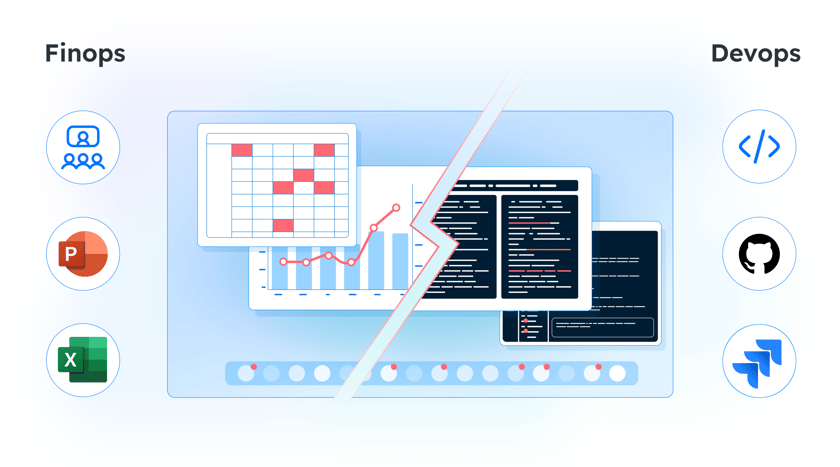
Maria’s priorities are delivering secure and reliable features according to the specifications. The cost of the underlying infrastructure is not part of her daily routine and only adds to her already busy days. Cost management only intersects with her world when major cost issues arise or as yet another aspect of monthly reviews, quarterly business reports, and annual planning cycles that rarely intersect with daily engineering operations. This disconnect creates a gap between where cost insights exist and where engineering decisions happen. Existing FinOps tools are not designed to close that gap and are rarely used by engineers.
The DevOps Revolution That Cost Management Missed
Engineering teams have successfully embraced workflow-native approaches for other operational concerns. Within a year of moving to a DevOps approach, engineers at Amazon were able to deploy code on average every 11.6 seconds¹¹. This transformation occurred because DevOps tools were integrated directly into development workflows rather than operating as separate disciplines.
Security successfully shifted left through platforms that embed vulnerability scanning directly into CI/CD pipelines. Quality assurance is integrated into development through automated testing frameworks and continuous integration. DevOps tooling and automation of the software delivery process established collaboration by physically bringing together the workflows and responsibilities of development and operations⁵.
Infrastructure management followed the same pattern. The rise of Infrastructure as Code (IaC) platforms made it possible to treat infrastructure changes like software deployments, version-controlled, peer-reviewed, and continuously delivered. Reflecting this shift, more than half (54%) of the teams surveyed in DORA’s 2022 State of DevOps report named containers as their primary deployment target, indicating that infrastructure provisioning and management have become a standard part of modern development practices12.
Cost management, however, remains stubbornly external to these workflows. It exists as a separate discipline, with its own tools, metrics, and review cycles. This separation creates friction that prevents consistent optimization action.
Anatomy of Workflow Failure
Let's examine a typical cost optimization scenario to understand how workflow gaps prevent action with an example:
Last quarter, the FinOps team at a mid-sized SaaS company identified a clear opportunity: $35,000 per month of waste from underutilized instances and unattached storage spread across twelve microservices.

The analysis was thorough. The team had detailed utilization metrics, cost breakdowns, resource IDs, and estimated savings. They knew which instances consistently ran below their CPU utilization threshold and which storage volumes had remained unattached for weeks. The financial opportunity was substantial and well-documented.
Following industry best practices, the FinOps team created a comprehensive optimization report and scheduled a meeting with engineering leadership. The presentation was professional and data-driven, complete with utilization charts and projected savings calculations. Engineering leadership acknowledged the opportunity and committed to addressing the issues.
Here's where the optimization effort died. The FinOps report contained detailed financial analysis but lacked the operational context engineers needed to act safely:

Which instances were truly idle versus temporarily quiet during off-peak hours?

Which storage volumes were left unattached by design versus due to oversight?

What services would be impacted by instance rightsizing?
The Psychology of Engineering Priorities

Yet even with this alignment, the way cost optimization is framed inside engineering organizations limits its priority. Security vulnerabilities carry immediate risk to customer data or service availability. Performance issues directly affect user experience and business metrics. Feature requests drive product differentiation and revenue growth.
Cost inefficiency, although financially important, rarely triggers the same level of urgency. Idle instances don’t break customer experiences. Oversized storage doesn’t cause security incidents. Unoptimized Reserved Instance coverage doesn’t set off PagerDuty alerts.
Chapter 3: What Engineers Actually Need to Act
Integration Requirements
Just as DevOps tools automate manual tasks and keep engineers in control of complex systems, cost optimization must feel like engineering automation, not financial reporting.

Git is the center of most workflows. Pull requests are where engineers discuss code, quality, and implementation details. Embedding cost feedback here, showing the impact of infrastructure changes before deployment—naturally integrates optimization into daily decisions.
Slack or Teams serve as the operational nerve center. Engineers already use these platforms to receive alerts and coordinate responses. Delivering cost insights here would make them feel like part of operations, not finance.
Terraform and other Infrastructure-as-Code tools govern resource provisioning, but static analysis can only estimate costs—it can’t detect runtime inefficiencies. An instance may be properly sized in code yet sit underutilized in production.
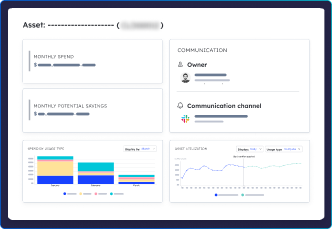
The harder problem is reverse mapping. FinOps tools might flag that instance i-1234567890abcdef0 has wasted money for 90 days, but which Terraform module created it? Which team owns it? What code needs to change? Tags were meant to solve this, but they decay quickly and rarely capture real ownership.
This is the core attribution gap in cloud cost optimization. Security issues can be fixed by editing code; cost issues require connecting runtime data with infrastructure definitions. Most organizations lack a reliable way to maintain that connection as systems evolve through CI/CD.
Engineers often see what needs to be fixed, but not how to do it. They receive optimization recommendations, then spend hours tracing ownership and code paths. The opportunity is clear, but the execution path remains hidden.
The Implementation Gap

Effective engineering tools provide implementation pathways, not just analysis. When Snyk identifies a security vulnerability, it doesn’t just flag the issue; it often provides specific code changes, upgrade paths, and risk assessments. When performance monitoring identifies bottlenecks, it typically includes specific metrics, thresholds, and optimization techniques.
Cost optimization needs similar implementation support. Instead of identifying underutilized instances, tools should provide specific configuration changes, performance validation steps, and rollback procedures to address these instances. Instead of recommending Reserved Instance purchases, they should provide exact purchase recommendations with usage forecasts and commitment strategies.
A major source of context for these recommendations has traditionally been tagging. FinOps programs often mandate strict tagging frameworks to attribute costs and track ownership. But tagging is cumbersome to enforce, prone to errors, and difficult to maintain as systems evolve. Tags go stale when services are refactored or when the engineers who created the resources move on. Over time, entire cost categories can become misattributed or orphaned, eroding trust in the data and leaving engineers skeptical of the recommendations built on it.
This implementation gap is particularly challenging because cost optimization often requires coordinating changes across multiple systems and teams. Rightsizing an instance might require updating auto-scaling configurations, monitoring thresholds, and load balancer health checks. Traditional cost management won’t dive that deep into implementation details, but those details are the core of the work.
Building Cost Literacy
Perhaps most importantly, engineers need opportunities to develop cost literacy —the ability to make architectural and configuration decisions that naturally balance cost efficiency with other requirements. This literacy develops through repeated exposure to cost-performance tradeoffs and clear feedback on optimization decisions.
In highly evolved IT teams, cost has become a first-class metric. Whether it's from unplanned activity or cost spikes from surprise billing, keeping cloud costs under control is a key DevOps initiative this year¹⁰. This observation from CloudZero suggests that leading engineering organizations are beginning to treat cost as an operational metric rather than a separate financial concern.

Building cost literacy requires engineers to understand not just what to change, but why those changes create savings and how they affect other system characteristics. It means exposing the analysis behind recommendations and providing clear feedback on optimization results.
Engineers who develop strong cost literacy begin making efficient architecture decisions naturally, without requiring external optimization recommendations. They choose appropriate instance sizes, implement effective auto-scaling policies, and design systems that scale cost-effectively. This proactive cost efficiency delivers far greater value than reactive optimization of inefficient systems.
Chapter 4: The CxM Approach - Reframing Cost as Engineering Work
Architecture of Integration

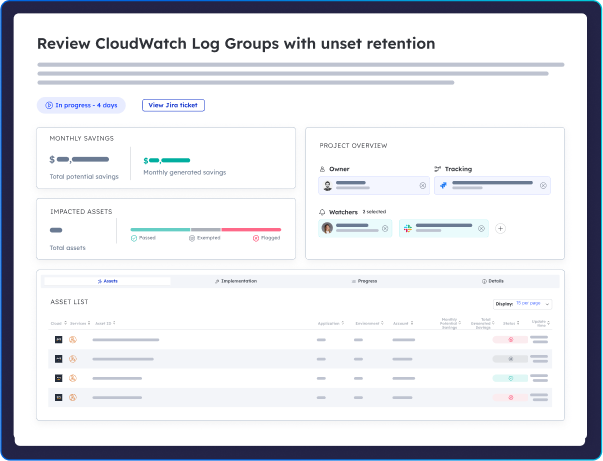
AI-powered remediation goes beyond static recommendations. It starts with the operational context (i.e., the runtime environment where issues are detected, including metadata about the application, service, and environment). It then incorporates organizational patterns, defined as non-functional requirements that reflect a team’s north stars. By tracing these signals back to the code that deployed the faulty infrastructure, the system generates targeted, contextualized code changes such as Terraform edits, configuration updates, and infrastructure-as-code patches, paired with runbook-style guidance on how to apply them.
Automatic ownership mapping connects optimization opportunities with engineers best positioned to implement them. The platform analyzes service topology, code ownership patterns, and team assignments to provide route recommendations that are tailored appropriately. When an optimization opportunity arises in the authentication service, complete with proposed code changes, it is routed to the backend team that owns authentication, rather than to generic platform teams.
The delivery layer integrates with existing engineering tools to provide implementation-ready fixes through familiar interfaces, ensuring seamless integration. GitHub pull requests include the actual infrastructure changes, along with a cost impact analysis. Slack channels receive optimization notifications with technical context and code diffs. Jira tickets are created with specific pull request links and estimated effort. The platform generates comprehensive fixes that engineers can review, modify, and deploy through their standard development processes, while maintaining full control over the changes that are implemented.
Practical Implementation
Consider how this approach transforms typical optimization scenarios. Traditional cost management might identify $18,000 monthly spending on idle development environments across multiple services. The CxM approach instead generates specific, actionable tasks for individual engineers with clear ownership assignment and financial impact: "The analytics-dev environment for your team has been idle for 12 days and costs $280 monthly."
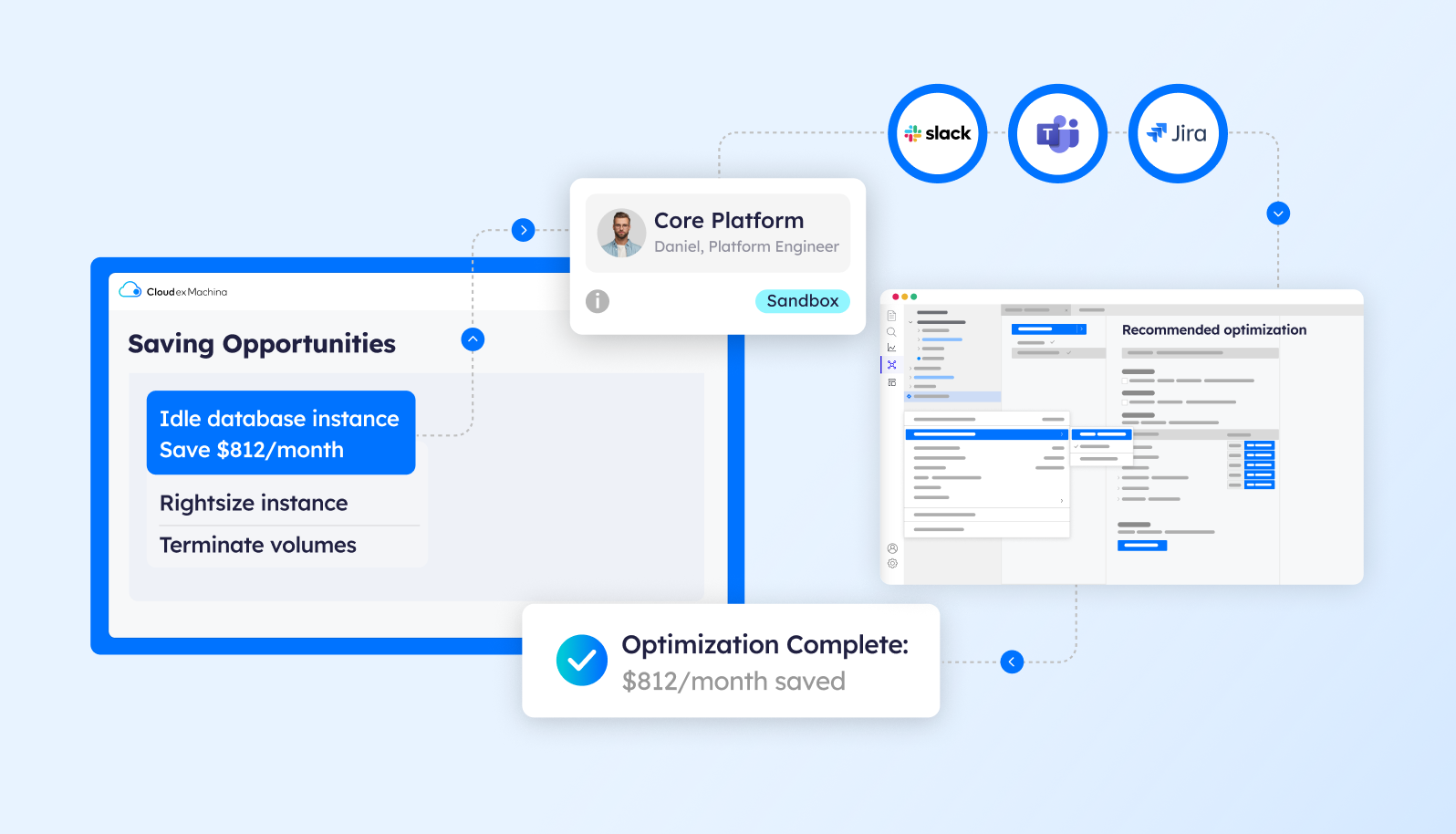
The recommendation includes specific financial impact and clear ownership assignment. The engineer doesn't need to investigate usage patterns or coordinate with other teams. They can either take immediate action or actively choose to postpone the optimization with a business justification, preventing recommendations from languishing indefinitely in ticket backlogs.
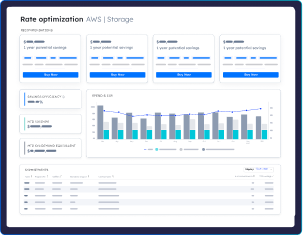
Reserved Instance optimization is another case where implementation details matter. Traditional platforms stop at vague advice, such as “increase RI coverage for compute workloads.” CxM ties the recommendation directly to the operational context. For example: “Your cloud has run 4× new c5.4xlarge instances 24/7 for 90 days straight (99.8% uptime). You’re losing $1,056/month on predictable workload costs. Commit for 3 years = $12,672/year saved upfront for $9,792. (129% ROI). [Auto-Purchase RIs] ← Click to execute.” Instead of leaving engineers with abstract guidance, CxM presents workload-specific evidence, projected savings, and a one-click path to action, fully grounded in the runtime environment.
The platform handles the complexity of commitment optimization while providing engineers with the specific technical details needed to make informed infrastructure decisions.
 Configuration optimization often requires the most technical context. Traditional cost management may identify oversized storage volumes or excessive backup retention, but it often lacks specific guidance on how to modify these areas.
Habit Formation Through Practice
The CxM approach builds cost-conscious habits through systematic practice rather than training or policy mandates. When engineers regularly receive and act on cost optimization recommendations, they naturally develop a deeper understanding of cost awareness and optimization intuition. They begin considering cost implications during architecture decisions and infrastructure planning.
This behavioral shift occurs gradually through positive reinforcement, rather than through dramatic process changes. Engineers view cost optimization as a helpful automation rather than an additional overhead. They see clear connections between their technical decisions and business outcomes. They develop confidence in their optimization abilities through successful implementation experiences.
The platform also supports broader organizational effectiveness by providing data and insights that help FinOps teams focus on strategic activities rather than managing operational tasks. Instead of manually identifying optimization opportunities and chasing engineering teams for implementation, FinOps professionals can focus on commitment strategies, architecture reviews, and cost forecasting.

Engineering managers gain visibility into their teams' cost impact without requiring separate reporting or analysis systems. They can see which engineers excel at cost optimization and which might benefit from additional support. They can factor cost efficiency into performance reviews and career development conversations naturally.
Over time, these individual habit changes aggregate into evolved working practices. Teams naturally begin incorporating cost considerations into their standard workflows, not because of mandated processes, but because the tools make it easier to do the right thing than to ignore cost implications.
Conclusion: Closing the Workflow Gap


Cost Optimization Velocity: how quickly teams act on recommendations; days, not weeks.

Engineering Cost Ownership Index: how many teams are actively tracking cost KPIs in their development process, measuring real ownership rather than passive awareness.

Waste Prevention Rate: how effectively engineering teams avoid waste during initial development, before systems go into production.
 The organizations that achieve this integration will enjoy a lasting competitive advantage. They will operate more efficiently while maintaining higher engineering productivity. Their infrastructure costs will scale predictably with business growth, allowing them to redirect engineering talent from cost firefighting to innovation and product development.
Technology will accelerate this shift. AI models will predict usage patterns and recommend optimal configurations before code is merged. Infrastructure-as-Code integrations will surface cost implications in real time as engineers design systems. Slack, GitHub, and CI/CD pipelines will become the primary interfaces for cost optimization, eliminating the need for separate dashboards.
The ultimate state? Engineers no longer “do” cost optimization; it simply happens as a byproduct of building, deploying, and operating high-quality systems.
The choice is clear: continue chasing savings through external optimization efforts, or enable savings through integrated engineering practices. The organizations that choose integration will not only solve their cost challenges, but they will transform how they build and operate technology systems. The workflow gap represents both the greatest challenge and the greatest opportunity in cloud cost management. Close it, and cost optimization becomes a natural byproduct of excellent engineering. Leave it open, and remain trapped in the cycle of sophisticated observation without systematic action.
Sources and References