

Deployment pipelines have gotten faster. Infrastructure has gotten more complex. And the cognitive overhead required to manage both, at scale, reliably, has grown in ways that scripted automation alone can no longer absorb. That's the gap AI DevOps is filling.
Engineering teams are embedding AI into the workflows they already run, using it to reduce toil, compress feedback loops, surface risks earlier, and close the gap between infrastructure insight and engineering action. The productivity claims are real. So are the trade-offs.
This article is written for engineering leaders and practitioners who are past the question of whether AI belongs in DevOps and are now working through the harder questions: where to integrate it, what it actually delivers, and what it costs you when it goes wrong.
Key Takeaways:
- AI DevOps differs fundamentally from traditional automation. AI systems learn from patterns, adapt to new signals, and generate outputs; they don't just execute predefined rules.
- The highest-leverage applications today are testing, incident management, code review, and infrastructure cost optimization.
- Successful adoption depends on data quality, workflow integration, and measuring outcomes against defined KPIs before deployment begins.
- AI outputs adopted inside the tools engineers already use outperform those delivered through separate dashboards requiring context-switching.
- Verified business impact requires closed-loop measurement. Define the KPIs first, then instrument for change.
What Is AI DevOps?
AI DevOps is the integration of artificial intelligence and machine learning capabilities into the software delivery lifecycle, enabling engineering teams to automate more complex decision-making, surface patterns across large volumes of operational data, and act on infrastructure signals with greater speed and precision.
Distinguishing AI in DevOps from traditional automation matters. Traditional automation executes predefined rules: if condition X occurs, trigger action Y. It's deterministic, auditable, and reliable within well-scoped boundaries. AI systems, on the other hand, learn from historical data patterns, adapt to new signals that weren't explicitly anticipated, and generate outputs rather than simply triggering them. For example, you could set up an automated alert threshold that fires when CPU usage exceeds 90%. But an ML-based anomaly detection model can go further by learning what "normal" looks like for a specific service and flag deviations that would never match a static rule.
This difference is important to note. Some workflows benefit from strict, predictable execution, while others involve enough variability and context-dependence that rule-based automation breaks down, which is where AI earns its place.
What Is AI, and How Does It Apply to Engineering Workflows?
Three categories of AI technology are most relevant to DevOps practitioners today.
- Supervised and unsupervised ML models are trained on historical data to recognize patterns and make predictions. In DevOps contexts: anomaly detection, predictive failure analysis, and capacity forecasting.
- Large language models (LLMs) and generative AI operate on natural language and code, enabling inline code suggestions, automated test generation, PR summarization, documentation generation, and incident description synthesis. Most DevOps engineers have already encountered these through GitHub Copilot, AI-assisted commit messages, and LLM-generated runbook drafts.
- Autonomous AI agents are systems capable of multi-step task execution across tools without requiring human handoff at each step. Early DevOps agent use cases include end-to-end issue remediation (diagnose, generate fix, open PR, notify owner) and cross-system workflow automation. These aren't yet production-standard for most teams, but they're progressing faster than most adoption timelines anticipated.
How Does AI Apply to DevOps?
DevOps is built on three properties:
- Automation
- Collaboration
- Rapid feedback loops
Code flows continuously from commit through build, test, and deployment. Teams own their services in production. Observability data feeds back into development decisions.
Those properties make DevOps receptive to AI. The data DevOps generates, including deployment events, test results, infrastructure metrics, and incident timelines, is exactly the signal AI models need. The workflow structure provides natural integration points for AI outputs.
The goal isn't to have AI replace engineers. AI is compressing cycle times and reducing cognitive overhead that scales poorly with infrastructure complexity. A senior SRE managing ten services can apply careful judgment to each one. Managing a hundred services at the same cognitive bandwidth requires tools that can absorb routine work and surface only what actually needs human attention.
Types of AI and Machine Learning Used in DevOps
The primary AI modalities appearing in production DevOps environments include:
- Supervised and unsupervised ML: anomaly detection, capacity forecasting, and failure prediction models trained on historical incident data
- Generative AI and LLMs: code generation and completion, test generation, PR descriptions, incident summarization, and documentation automation
- Reinforcement learning: pipeline optimization and autoscaling policy tuning that adapts to real usage patterns over time rather than responding to static thresholds
- AI agents: autonomous multi-step workflows executing across tools without per-step human handoff, currently most mature in incident response and code remediation
Benefits of AI in DevOps

The strongest case for AI in DevOps is built on measurable engineering outcomes rather than efficiency claims. The DORA framework gives you the right approach: deployment frequency, change failure rate, mean time to recovery (MTTR), and lead time for changes. AI's contribution to each of these is traceable and, with proper instrumentation, quantifiable.
Faster Feedback Loops Across the Delivery Pipeline
Traditional CI runs execute a full test suite regardless of which files changed. Intelligent test selection runs only the tests statistically likely to catch regressions given the specific changeset, cutting run times substantially without sacrificing meaningful coverage. At scale, that gain compounds across hundreds of daily commits into a significant reduction in developer idle time and a measurable improvement in deployment frequency. The pipeline stops doing unnecessary work. Lead time for changes shortens not because engineers work faster, but because the system works smarter.
Improved Change Failure Rates Through Predictive Analysis
ML models trained on historical deployment data can evaluate incoming changesets against factors that correlate with production failures: code complexity, test coverage gaps, deployment timing, and similarity to past changesets that failed. This is a preventive capability that static CI gates can't provide. Traditional quality gates check for known patterns. Predictive models surface risk signals that haven't been explicitly defined yet. High-risk changes get flagged for additional review or staged rollout before they reach production, without requiring manual risk assessment on every deployment.
Reduced Toil Through Intelligent Automation
Log triage, alert noise reduction, resource rightsizing evaluations, and dependency scanning represent a significant share of SRE and platform engineering time. AI can absorb a meaningful portion of that work and redirect capacity toward higher-leverage problems.
The key distinction from scripted automation is adaptability. A script that filters alert noise based on defined rules breaks when the environment changes. An ML-based correlation system learns what noise looks like as the system evolves. For teams operating in complex, rapidly changing infrastructure, that adaptability is the difference between a tool that requires constant maintenance and one that actually reduces operational overhead over time.
Enhanced Security Posture Without Slowing Delivery
AI can surface vulnerability patterns, suggest remediation steps, and flag misconfigurations inline, integrated into the developer workflow rather than surfaced post-deployment in a separate security review. Inline security feedback during code authoring, automated dependency scanning with suggested version pins, and configuration analysis that catches non-compliant resource settings before deployment all reduce the window between introducing a vulnerability and catching it. For teams without dedicated security resources embedded in every squad, this shifts security left without adding a manual process layer.
How AI Influences DevOps: Summary
|
DevOps KPI |
How AI Influences It |
Example Mechanism |
|
Deployment Frequency |
Faster pipeline feedback, reduced bottlenecks |
Intelligent test selection, automated build prioritization |
|
Change Failure Rate |
Predictive risk flagging before production |
ML models scoring changeset risk against historical failure data |
|
MTTR |
Faster diagnosis, automated remediation suggestions |
AI-generated incident summaries, root cause analysis from logs |
|
Lead Time for Changes |
Reduced idle time, automated review tasks |
AI-assisted code review, automated documentation generation |
|
Infrastructure Cost |
Continuous rightsizing, idle resource detection |
ML-driven usage analysis with ownership-attributed recommendations |
How Can a DevOps Team Take Advantage of AI? Key Use Cases
DevOps teams can take advantage of AI by embedding it into the specific workflows where the combination of high data volume, repetitive decision-making, and speed requirements creates the most friction. In practice, that means using AI to accelerate testing and quality assurance, reduce noise and diagnosis time in incident management, improve code review throughput, optimize infrastructure costs continuously, and automate compliance and deployment orchestration at enterprise scale.
AI in DevOps Testing and Quality Assurance
Writing tests for existing code is unglamorous work that rarely makes it to the top of a sprint backlog. Generative AI addresses that directly: given existing code or specifications, it can produce unit tests, integration tests, and edge-case scenarios that close coverage gaps engineers haven't had time to fill. Intelligent test selection takes it a step further. Rather than running a full test suite on every change, it runs only the tests most likely to catch regressions based on the specific files modified, cutting run times without dropping the coverage that actually matters.
There are real trade-offs here. AI-generated tests can be syntactically valid without being logically correct. A model doesn't know which behaviors are critical in production; it only knows what the code does. Test quality scales with the quality of the codebase being analyzed and how well the prompts are structured. Teams that merge AI-generated tests without review are accepting false confidence in their coverage, which can be harder to recover from than a known gap.
Using AI in CI/CD Pipelines
AI integrates into pipeline orchestration through intelligent build caching, predictive resource allocation for CI runners, and automated rollback triggers based on real-time deployment signal analysis rather than static thresholds.
The limitations here deserve direct attention. AI-driven pipeline decisions introduce non-determinism into a system where reproducibility is a core engineering assumption. If a model decides to cache a build artifact that a deterministic system would have rebuilt, diagnosing a downstream failure becomes materially harder. Teams evaluating AI in delivery pipelines need to account for auditability requirements upfront, particularly in regulated environments where every deployment decision may need to trace back to a human-reviewable rule. Starting with AI in an advisory role and progressing to automated action only in well-bounded scopes is the lower-risk path.
AI Role in DevOps Incident Management
Incident management is one of the highest-leverage areas for AI in operations. The cognitive load on an on-call engineer during a production incident is substantial: correlating alerts across multiple systems, parsing logs to identify root cause, drafting communications, and coordinating remediation all at once.
Automated alert correlation reduces noise by grouping related alerts into coherent incidents rather than surfacing dozens of individual notifications from a single underlying failure. AI-generated incident summaries give on-call responders a structured description of what's failing, what changed recently, and how similar incidents resolved previously. Natural language root cause analysis surfaces the log entries and infrastructure signals most likely to explain the observed behavior. Recommended remediation steps draw on historical runbook data and past resolutions.
One constraint matters above the rest: AI in incident management is most effective when it reduces time-to-diagnosis. It shouldn't be positioned as a replacement for experienced SRE judgment, particularly in novel failure modes where historical patterns don't apply. The model's recommendations are starting points, not conclusions.
Generative AI in DevOps for Code Generation and Review
LLM-assisted code generation is the most widely adopted AI capability in developer workflows as of 2025. Inline suggestions, PR descriptions, automated documentation, and commit message generation have moved from experimental tooling to standard practice for a large share of engineering teams.
Developers using AI code completion tools report meaningful reductions in time spent on boilerplate and context-switching. The risks are equally documented: hallucinated logic that passes review because it looks plausible, insecure code patterns that don't get caught by standard linting, and the more gradual risk of over-reliance degrading code comprehension among engineers who lean on suggestions without developing the underlying understanding those suggestions are meant to accelerate.
The secure data flow dimension is especially important for enterprise teams. Any LLM ingesting source code, infrastructure configuration, or production telemetry creates a data governance question. Teams need clear policies on what code and data their AI tooling is exposed to, how that data is retained, and whether cloud-hosted AI services are permissible under their compliance requirements. That's not a reason to avoid AI-assisted code generation. It's a prerequisite for adopting it responsibly.
AI and Machine Learning for Infrastructure Cost Optimization
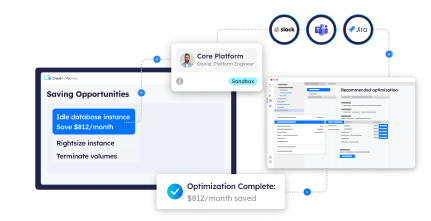
When AI continuously monitors workload patterns, detects idle or oversized resources, and generates recommendations with clear ownership attribution, it closes the gap between infrastructure insight and engineering action. This is directly relevant to teams experiencing the FinOps Paradox: cloud waste is visible in dashboards, but meaningful remediation doesn't happen because recommendations don't reach the right engineers with sufficient context to act.
Developer-first cost optimization means recommendations land where engineers work, not in a separate cost management platform that requires a dedicated login. A rightsizing suggestion delivered as a pull request into an engineer's existing review queue is more likely to result in action than the same suggestion surfaced in a dashboard they check monthly. An idle resource notification in Slack, with ownership already attributed and context already provided, is more likely to be resolved than a report requiring manual investigation to determine who owns the asset.
This is the difference between cost management as a reporting function and cost management as an engineering workflow. With ML, continuous usage pattern analysis identifies resources whose consumption doesn't justify their provisioned capacity, compares configuration against cost-performance alternatives, and connects those findings to the engineers whose deployment decisions created them. Cloud ex Machina (CxM) applies exactly this model: it infers resource ownership automatically from deployment history and access patterns along tags, then routes rightsizing and configuration recommendations to the responsible engineer as a pull request, Slack message, or Jira ticket, not a dashboard alert. The three optimization levers (rate, usage, and configuration) each have distinct data requirements and recommendation patterns and AI-driven systems that address all three deliver materially more value than those focused on a single dimension.

How Enterprises Use AI in DevOps Pipelines
Enterprise-scale AI DevOps adoption looks materially different from startup adoption. Integration complexity is higher, data governance requirements are stricter, and auditability expectations are embedded in procurement decisions from the start.
Practical enterprise applications include intelligent deployment orchestration across multi-region environments, AI-assisted compliance checks integrated directly into release gates, and ML-powered capacity forecasting for cloud commitment planning. Aligning reserved instance and savings plan purchases to predicted workload trajectories rather than backward-looking averages meaningfully improves commitment utilization and reduces overcommitment risk.
AI in Enterprises: Use Cases
|
Enterprise Use Case |
AI Capability Applied |
Business Outcome |
|
Multi-region deployment orchestration |
Predictive risk scoring, traffic analysis |
Reduced change failure rate across global fleet |
|
Compliance gate automation |
Configuration analysis, policy matching |
Faster releases without manual compliance review |
|
Cloud commitment planning |
ML capacity forecasting |
Improved RI/SP utilization, reduced over-commitment |
|
Incident response at scale |
Alert correlation, automated summarization |
Reduced MTTR across high-volume alert environments |
|
Infrastructure cost attribution |
Ownership inference, usage pattern analysis |
Verified cost reduction with traceable engineering actions |
Enterprise adoption of AI tends to be phased and deliberate. A Stanford analysis of 51 successful enterprise AI deployments showed that high performers consistently set one to two year timelines to move from pilot to broad production rollout, which is a deliberate pace driven by integration complexity, vendor security review, and organizational alignment. The architecture decisions made early, particularly around data governance and workflow integration points, have consequences that outlast the pilot phase.
Limitations and Trade-offs: The Honest Case for AI in DevOps

AI in DevOps delivers real productivity gains, but it also introduces complexity, risk, and failure modes that don't announce themselves until they've already caused a problem. Non-determinism, data dependencies, security gaps, and the gradual erosion of engineering judgment are the trade-offs teams rarely discuss during the evaluation phase. Understanding them before deployment is what separates a successful AI integration from one that creates more toil than it eliminates.
Where AI in DevOps Underdelivers
Non-deterministic outputs in delivery pipelines complicate debugging in ways that are hard to anticipate until you're in the middle of an incident. One engineer described a telling example from a sandbox environment: an AI agent made an erroneous networking change to a Kubernetes cluster, then rapidly compounded the problem, ultimately recommending the cluster be deleted and recreated rather than pausing to snapshot or assess the damage first. The instinct to preserve state and evaluate blast radius before taking further action comes from having been burned before. AI doesn't have that instinct.
Data Quality, Security, and Governance Considerations
AI models are only as reliable as the data they're trained or fine-tuned on. For DevOps applications, this means clean, labeled historical incident data for anomaly detection; accurate cost and usage telemetry for resource optimization; and well-maintained code repositories for code generation and review. Any AI system that ingests production telemetry, source code, or infrastructure configuration raises data governance questions, particularly for teams operating in regulated industries or multi-cloud environments. Establishing data governance policies before deployment, not after, is a prerequisite, not a post-launch task.
AI Augments Engineers Rather Than Replace Them
AI in DevOps shifts the value of engineering skills toward higher-order judgment, including architectural reasoning, system design, and cross-functional coordination, and away from repetitive execution. DevOps engineers who develop fluency with AI tooling, understand its failure modes, and can evaluate its outputs critically are well-positioned. The more realistic concern isn't replacement but skill atrophy: over-reliance on AI-generated outputs without developing the underlying understanding those outputs are meant to accelerate. Engineers who treat AI suggestions as conclusions rather than starting points are accumulating a different kind of risk.
How to Start Using AI in DevOps: A Practical Approach for Engineering Teams
Step 1: Identify High-Frequency, Low-Ambiguity Workflows First
The most successful AI DevOps implementations start with well-defined, repetitive processes where AI augments a task engineers already perform and where outputs can be validated before they drive consequential decisions. Test selection, alert triage, and deployment health verification are strong starting candidates. Novel incident response and autonomous infrastructure changes are not. The selection criterion is practical: can an engineer evaluate the AI's output quickly using existing knowledge? If evaluating the output requires as much effort as doing the task manually, the AI isn't providing leverage.
Step 2: Ensure Data Readiness Before Deploying AI Models
Before deploying anomaly detection or predictive failure models, teams need clean telemetry, consistent resource attribution, and sufficient historical data to configure models meaningfully. For most organizations, that means auditing observability coverage before AI tooling evaluation begins. Skipping this step is the single most common reason AI DevOps pilots fail to deliver on their initial promise, and the organizational cost of a failed pilot is disproportionate to the time a data readiness assessment would have required.
Step 3: Integrate Into Existing Workflows
Adoption scales when AI outputs land in the tools engineers already use. A pull request surfacing a rightsizing recommendation in an existing review queue is more likely to result in action than the same recommendation in a separate optimization platform. An incident summary delivered in the on-call tool outperforms a report requiring a separate login. This principle applies across every AI DevOps use case: the workflow integration point determines whether AI outputs become engineering actions or become ignored notifications.
Step 4: Instrument for Verification and Measure What Changes
Define KPIs before deploying AI in DevOps: change failure rate, MTTR, deployment frequency, idle resource percentage, and cost per deployment unit. These metrics create the closed loop that separates AI DevOps programs with verified business impact from those that generate activity without measurable outcomes. Without predefined measurement, there's no way to distinguish genuine improvement from noise or to make a credible case for continued investment.
From AI-Assisted to AI-Driven: Building a DevOps Practice That Measures What Matters
The engineering teams getting durable value from AI DevOps share a pattern:
- They embed AI outputs in existing workflows rather than deploying AI as a parallel reporting layer.
- They tie recommendations to measurable business targets rather than abstract efficiency goals.
- They verify outcomes through closed-loop measurement, confirming that actions taken on AI outputs actually moved the KPIs those outputs were deployed to improve.
That closed loop is what converts AI DevOps from a capability investment into a demonstrated business outcome. The metrics that matter are straightforward:
- Change failure rate
- MTTR
- Deployment frequency
- Infrastructure cost efficiency
These connect engineering practice directly to business performance. AI that measurably improves them earns organizational trust and budget. AI that generates activity without moving those numbers doesn't survive the next planning cycle.
Cloud ex Machina (CxM) structures developer-first cloud optimization on exactly this model: AI-generated infrastructure recommendations delivered inside engineering workflows, with automatic ownership attribution and closed-loop KPI verification built in.
See how it works by booking a demo with CxM today.